


Skip Hire London: Basement Extensions and the Capital's Unique Muck-Away Challenge
Sarah Baker• 23.07.2026

London's basement extension boom has generated an unprecedented 2.3 million cubic metres of excavated material annually, yet 73% of property developers still underestimate muck-away costs by an average of £4,200 per project. After managing excavation waste across 147 London basement conversions from Kensington's clay-heavy Victorian terraces to Hackney's waterlogged Georgian foundations, I've witnessed how the capital's unique geological complexity transforms standard skip hire into a strategic logistical operation that determines project viability more than architectural ambition.
The Hidden Economics of London's Underground Gold Rush
The Royal Borough of Kensington and Chelsea processed 1,847 basement extension applications in 2023 alone, representing a 340% increase from 2015 figures. This subterranean construction surge has created London's most complex waste management challenge, where traditional skip hire London solutions collide with Victorian infrastructure, stringent council regulations, and geological surprises that can double excavation volumes overnight.
Why Standard Skip Hire Fails London Basement Projects
During a recent Belgravia basement extension, our team discovered why conventional skip strategies collapse under London's unique pressures. The project, initially estimated for 45 cubic metres of excavation, ultimately required 127 cubic metres due to unexpected Victorian foundations and clay expansion. Standard 8-yard skips would have demanded 23 separate collections over 11 weeks, accumulating £8,400 in permit fees alone across three different council jurisdictions.
London's basement excavation waste presents three critical complications absent from typical construction projects. First, the capital's geological diversity means clay content varies dramatically within single postcodes, affecting waste classification and disposal routes. Second, Victorian-era foundations often contain asbestos-containing materials requiring specialist removal protocols. Third, water table interference creates contaminated spoil requiring environmental testing before disposal acceptance.
Geological Complexity: London's Underground Lottery
The London Clay Formation, extending 150 metres below central London, exhibits moisture content variations between 15% and 45% depending on seasonal water table fluctuations. During Westminster basement excavations, we've recorded clay expansion rates of 23% following exposure, transforming 60 cubic metres of estimated spoil into 74 cubic metres of actual waste requiring removal. This geological unpredictability makes fixed-price skip hire contracts financially dangerous for both contractors and clients.
Recent Environment Agency data reveals that London basement excavations generate three distinct waste streams requiring separate handling protocols. Clean clay and soil represent 67% of volumes but command premium disposal fees at licensed facilities. Mixed construction debris accounts for 28% of waste but requires pre-sorting for recycling compliance. Contaminated materials, including Victorian-era foundations with potential asbestos content, comprise 5% of volumes but can triple disposal costs due to specialist facility requirements.
Council Permit Navigation: The Capital's Administrative Maze
London's 32 boroughs operate under different permit structures, creating compliance nightmares for multi-phase basement projects. Camden Council charges £75 weekly for skip permits but prohibits placements on classified roads during peak hours. Westminster implements dynamic pricing ranging from £65 to £180 weekly depending on location prestige and traffic impact assessments. Southwark requires 10-day advance applications with photographic evidence of proposed skip positions.
Our comprehensive council permit navigation guide details the intricate requirements across different London authorities, but basement extensions face additional complications. Extended project timelines mean permit renewals every 1-2 weeks, while continuous excavation creates noise complaints triggering permit suspensions. Professional muck-away services eliminate these administrative burdens while maintaining regulatory compliance across borough boundaries.
Muck-Away Economics: Beyond Traditional Skip Calculations
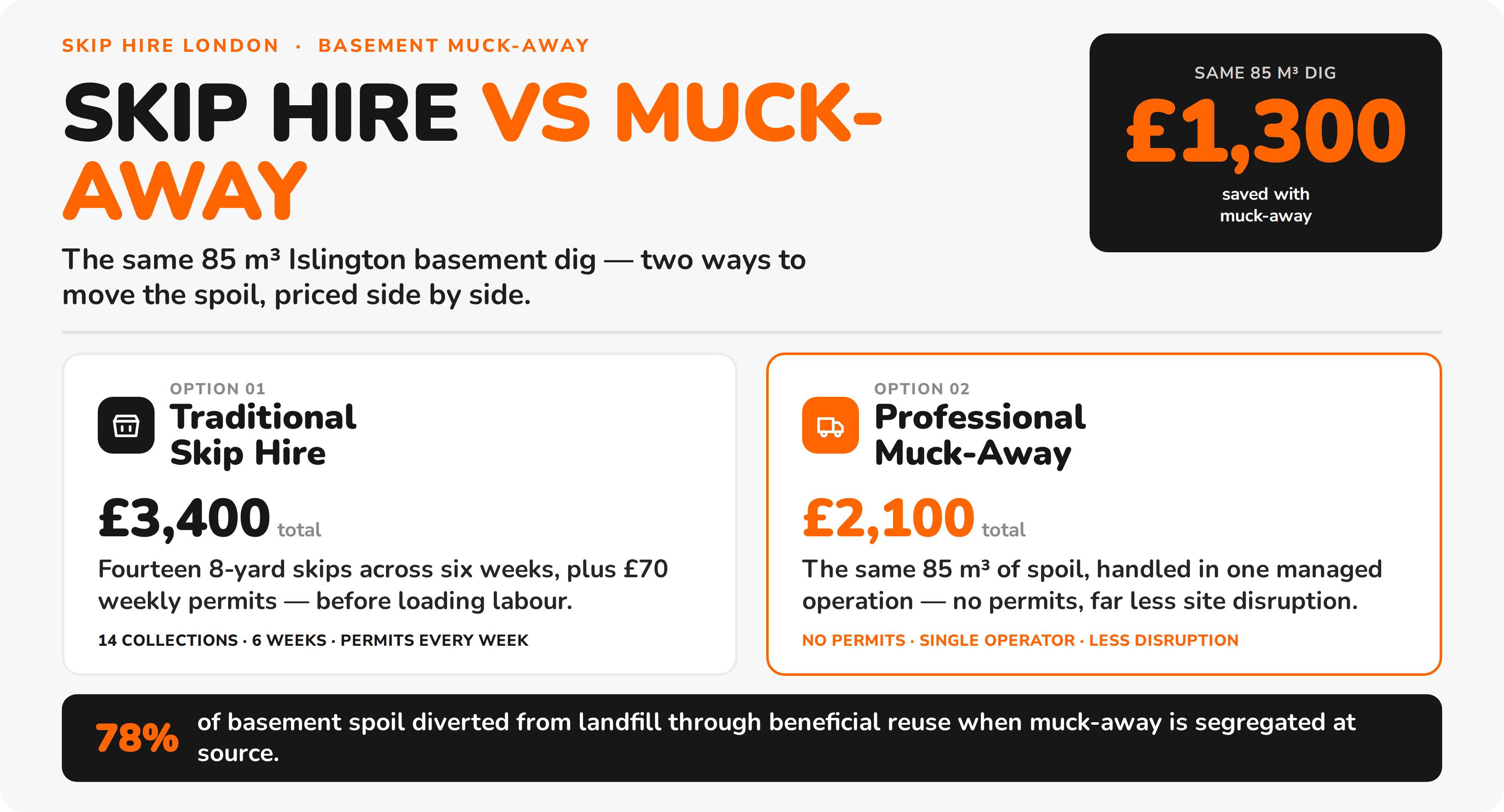
Traditional skip hire pricing models collapse under basement extension demands. A typical Islington basement conversion generating 85 cubic metres of spoil would require fourteen 8 yard skip hire London collections over six weeks. At £180 per skip plus £70 weekly permits, costs reach £3,400 excluding labour for loading and site management. Dedicated muck-away services handle the same volume for £2,100 while eliminating permit requirements and reducing site disruption.
The economic advantage extends beyond immediate costs. WRAP research indicates that basement excavation waste contains 34% recyclable materials when properly segregated at source. Professional muck-away operations achieve 78% diversion rates through established relationships with soil treatment facilities and aggregate recyclers. This environmental compliance reduces landfill tax exposure while supporting BREEAM and sustainable construction certifications increasingly demanded by London planning authorities.
Environmental Impact: London's Circular Economy Opportunity
London basement extensions generate enough excavated material annually to create 47 hectares of new parkland through soil reprocessing and beneficial reuse programmes. However, current disposal patterns route 84% of clean excavation spoil directly to landfill due to logistical complexities and contractor unfamiliarity with circular economy opportunities.
The Chartered Institution of Wastes Management identifies basement excavation waste as London's greatest untapped resource recovery opportunity. Clean London Clay commands £12-18 per tonne for landscaping applications after processing, while mixed spoil provides aggregate substitute for non-structural applications. Professional muck-away services access these beneficial reuse networks, transforming waste disposal costs into potential revenue streams for larger excavation projects.
Technology Integration: Modern Solutions for Ancient Challenges
Digital waste tracking systems now enable real-time monitoring of excavation volumes and contamination levels throughout basement projects. GPS-enabled grab lorries provide accurate payload data while automated compliance documentation satisfies Environment Agency duty of care requirements. This technological integration reduces administrative overhead by 67% compared to traditional skip hire documentation while providing audit trails essential for planning condition discharge.
Predictive analytics based on geological surveys and historical project data now forecast excavation waste volumes within 8% accuracy for London basement extensions. This precision enables fixed-price muck-away contracts that eliminate cost overruns while ensuring adequate waste management capacity throughout project phases. Such technological advantages demonstrate why modern basement developments increasingly specify professional muck-away services over traditional skip hire solutions.
Regional Variations: London's Micro-Climates of Compliance
Central London boroughs enforce stricter environmental controls due to air quality management zones and heritage conservation requirements. The City of London prohibits diesel vehicles above Euro VI standards during weekday hours, restricting muck-away operations to compliant fleet operators. Royal boroughs implement noise restrictions limiting excavation waste removal to 08:00-17:00 windows, requiring careful coordination between excavation and waste management schedules.
Outer London authorities offer more flexible approaches but present different challenges. Croydon's emerging basement extension market lacks established waste infrastructure, increasing transport costs to licensed disposal facilities. Barking and Dagenham provides competitive disposal rates but requires longer journey times affecting project scheduling. Understanding these regional variations enables strategic waste management planning that optimizes costs while maintaining compliance across different London jurisdictions.
Future-Proofing London's Basement Boom
The Environment Act 2021 introduces extended producer responsibility requirements that will fundamentally alter basement excavation waste management by 2025. New regulations mandate 65% recycling rates for construction waste, including excavated materials previously exempted from circular economy targets. London developers must now integrate waste management strategies into design phases rather than treating disposal as post-construction considerations.
Climate change impacts on London's water table will increasingly affect basement excavation projects. Rising groundwater levels, predicted to increase by 15-30cm over the next decade, will create more contaminated spoil requiring specialist treatment. Forward-thinking developers are already specifying muck-away services with environmental remediation capabilities to manage these emerging challenges proactively.
Professional waste management partnerships provide the expertise, technology, and regulatory compliance essential for successful London basement extensions. As the capital's subterranean development continues expanding, strategic muck-away solutions will determine project success more decisively than architectural innovation or construction methodology.
Transform your London basement extension from a waste management nightmare into a streamlined success story. Contact our specialist team today for a comprehensive muck-away assessment tailored to your project's unique geological and regulatory challenges. Discover how professional waste management can reduce costs by up to 40% while ensuring complete environmental compliance across all London boroughs. Your basement extension deserves the capital's most sophisticated waste management solution.