


Skip Hire Liverpool: Baltic Triangle Warehouse Conversions and Commercial Waste Chaos
Sarah Baker• 16.10.2026

Why mixed commercial waste from warehouse conversions needs careful planning in Liverpool's creative quarter
I was stood in what used to be a textile warehouse on Jordan Street one Tuesday morning in March 2023, watching a developer's team pull out decades of office partitions, fluorescent light fittings and enough cable to stretch back to the Mersey. The Baltic Triangle conversion waste was piling up faster than anyone had planned for, and by 11:30am I could see we'd massively underestimated what this job would throw at us.
The Baltic Triangle has become Liverpool's answer to Shoreditch, with old warehouses turning into loft apartments, co-working spaces and studios faster than you can get a highway permit sorted. But every one of these conversions creates the same headache. You're not just dealing with building rubble and timber offcuts.
You're handling mixed commercial waste that includes everything from asbestos ceiling tiles to WEEE equipment, often in quantities that need a 16 yard skip hire Liverpool service just for one floor of a building. And if you get the segregation wrong, the costs can spiral out of control faster than a Friday afternoon traffic jam on the M62.
What Makes Baltic Triangle Warehouse Conversions Different
These buildings weren't designed to be gutted and rebuilt every few decades. The warehouse on Jordan Street had been a textile mill, then light engineering, then divided into office units in the 1980s. Each use had left its mark in the waste stream.
The engineering phase had left metal shavings mixed into the concrete floor. The office conversion had brought suspended ceilings, probably with asbestos tiles from the look of them, though we had to wait for the survey to confirm that. And someone had installed enough networking cable to connect half of Liverpool, all of which needed pulling out before the new layout could go in.
Most residential projects give you a predictable mix of materials. Commercial waste segregation in these warehouse conversions means dealing with five or six different waste streams, often in the same room. I've learned to budget extra time just for the sorting.
The Hidden Costs of Poor Waste Planning
On that Jordan Street job, the client had booked two 12-yard skips expecting to handle everything as mixed building waste. By Wednesday afternoon we'd filled both skips and barely touched the electrical systems or the partition walls. The WEEE waste alone needed its own collection.
Mixed waste disposal costs £180 per tonne in Liverpool when it's properly segregated construction waste. When it's contaminated with office equipment, fluorescent tubes, or anything that looks like it might contain asbestos, that figure jumps to £340 per tonne or more. I watched one conversion project in the Ropewalks area rack up an extra £2,800 in disposal costs because they'd mixed everything together rather than separating it on site.
The planning stage matters more than most people realize. These warehouses often have three distinct phases of waste:
Strip-out phase with office equipment, carpets, and suspended ceilings
Structural changes producing brick, concrete, and steel waste
Services installation creating packaging waste, cable offcuts, and smaller volumes of mixed materials
Each phase needs its own approach to collection and disposal.
Navigating Liverpool Council's Commercial Waste Requirements
Liverpool Council has tightened up on Commercial waste segregation requirements since the Environment Act 2021 came into force. If you're a waste producer, which includes anyone commissioning a warehouse conversion, you have a duty of care that follows the waste from your site to its final destination.
I made the mistake of assuming this was just paperwork until I saw a developer get landed with a £1,200 fine for inadequate waste documentation. The council's enforcement team had traced mixed waste back to a Canning Street conversion where the paperwork didn't match what had actually been collected. The waste transfer notes showed construction waste, but the load contained office furniture and computer equipment that should have been processed as WEEE.
The council expects you to keep records for at least two years, and they want to see that you've made reasonable efforts to separate materials at source. On larger projects, that means having separate collection points for different waste streams, not just throwing everything into one large container and hoping someone else will sort it out.
Skip Sizes and Collection Logistics in the Baltic Triangle
The street layout in the Baltic Triangle wasn't designed for modern waste collection vehicles. Half the conversions I've worked on sit on narrow streets where a standard skip lorry can barely turn around. Jamaica Street is particularly tricky, and I've seen collection crews have to position skips three buildings down from where they're actually needed.
Skip hire Liverpool services need to factor in these access issues when planning collections. A 16-yard skip might be the right size for your waste volume, but if the collection vehicle can't reach your building, you'll end up paying for multiple smaller skips instead. On the Jordan Street job, we had to use four 8-yard skips positioned at different points along the street rather than two larger containers.
Highway permits add another layer of complexity. Liverpool Council charges £25 per day for skip permits, but the application needs to go in at least five working days before you need the skip in place. I've learned to apply for permits covering longer periods than I think I'll need, because extending a permit is easier than getting a new one issued quickly.
WEEE and Hazardous Materials in Office Clearances
Every warehouse conversion involves clearing out the previous tenant's equipment, and that's where the regulations get particularly sticky. WEEE regulations cover everything from desktop computers to the fluorescent light fittings that were standard in 1990s office fit-outs.
The Jordan Street building had 47 fluorescent fittings across two floors, plus a server room with equipment that looked like it hadn't been touched since 2008. All of that needed separate collection and processing, which meant finding a registered WEEE collection service rather than putting it in the construction skip.
Asbestos is the other major concern in buildings from this era. You can't put suspected asbestos materials in with general construction waste, and you can't make decisions about what's safe based on visual inspection alone. The survey for Jordan Street came back showing asbestos in the ceiling tiles and some of the pipe lagging, which meant bringing in a licensed removal contractor before any other strip-out work could begin.
Understanding waste classification confusion explained becomes crucial when you're dealing with multiple material types from different eras of building use.
Segregation Strategies That Actually Work on Site
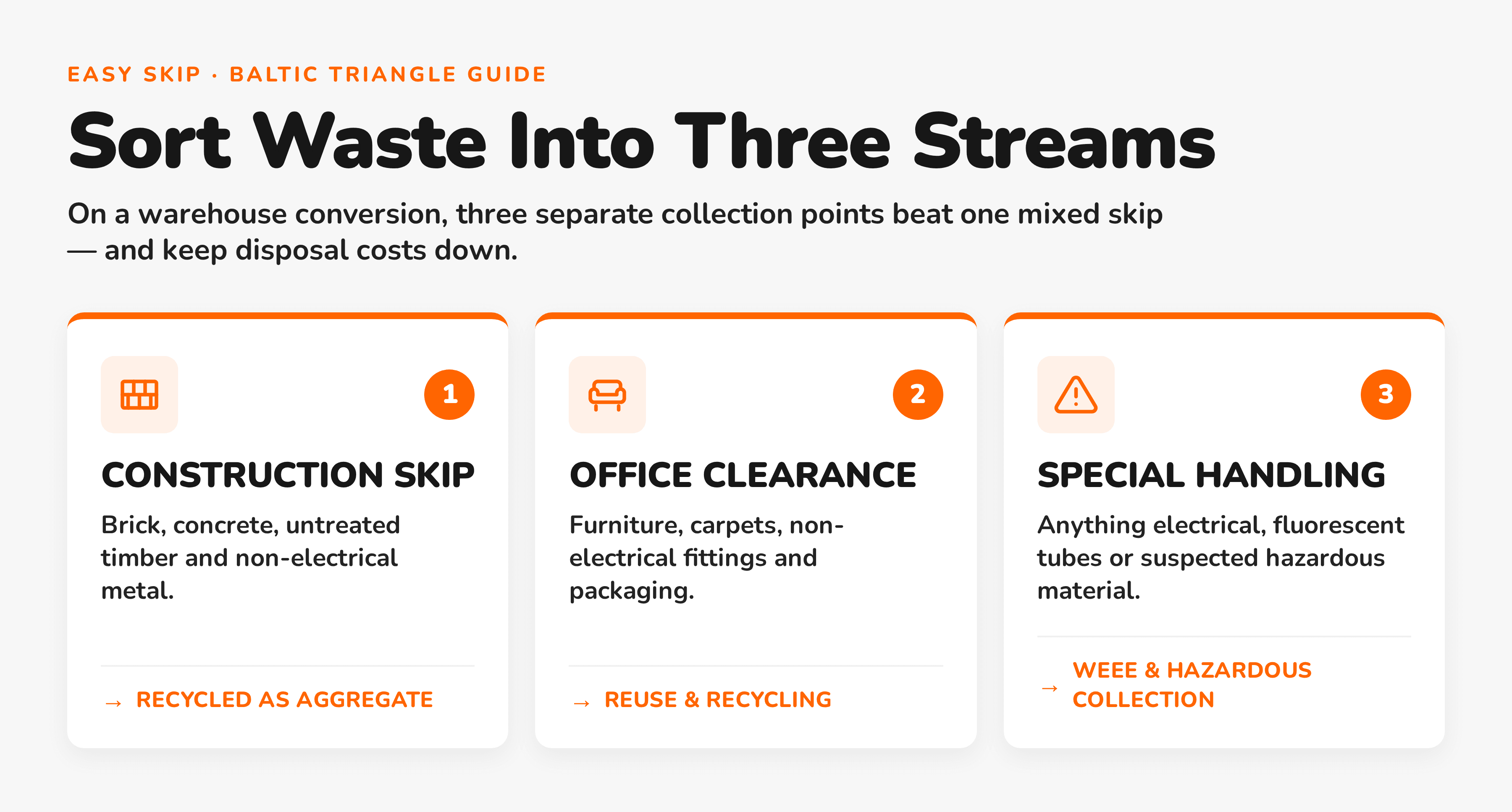
The key to successful commercial waste segregation is setting up systems before the work starts, not trying to sort materials after they're already mixed together. On warehouse conversions, I've found three separate collection points work better than trying to use one large skip for everything.
The first collection point handles clean construction waste like brick, concrete, and untreated timber. This can go in a standard construction skip and gets recycled at the lowest disposal cost. The second area is for office clearance materials that aren't WEEE, things like furniture, carpets, and general office waste. The third collection point is specifically for materials that need special handling.
Problems with on-site waste segregation for trades often come down to poor communication between different work crews rather than lack of understanding about what should go where. Labelling helps, but it needs to be specific rather than generic. Instead of signs saying 'general waste' and 'recycling', I use labels that list exactly what can go in each container:
Construction skip: brick, concrete, untreated timber, metal that's not electrical
Office clearance: furniture, carpets, non-electrical fittings, packaging
Special handling: anything electrical, fluorescent tubes, suspected hazardous materials
WEEE collection: computers, servers, electrical equipment with plugs or batteries
Hazardous waste: asbestos, paint cans, solvents, anything flagged in the pre-work survey
Cost Control Through Better Waste Management
The difference between well-managed and poorly managed waste streams can easily reach £3,000 on a typical warehouse conversion. On the Jordan Street project, proper segregation meant we could recycle 70% of the construction materials as aggregate, which brought the disposal cost down to £95 per tonne instead of the £180 we'd have paid for mixed waste.
The WEEE materials actually generated a small credit rather than a disposal cost, because the collection company could recover valuable metals from the server equipment. Even the office furniture found a second life through a local charity that helps community groups, which meant we avoided disposal costs entirely on about 2 tonnes of materials.
Skip hire costs become more predictable when you're planning for segregated waste streams. Instead of hoping that one large skip will handle everything and then discovering you need emergency collections for materials you can't mix, you can book the right combination of containers from the start. Services like easyskip.uk make it easier to coordinate multiple collections on different schedules.
Future-Proofing Waste Management in Urban Conversions
The Environment Act 2021 has made waste segregation a legal requirement rather than just good practice, and Liverpool Council is taking enforcement seriously. I expect the regulations to get stricter rather than more relaxed, particularly around construction and demolition waste from commercial properties.
Digital waste tracking is becoming standard, with QR codes on waste transfer notes that link to online tracking systems. The council can now follow waste streams in real-time, which makes it much harder to dispose of materials incorrectly without getting caught. Some of the larger skip hire Liverpool operators are already using GPS tracking on their vehicles and digital photography of loads to create automatic compliance records.
Climate considerations are also changing how waste gets processed. Liverpool Council has committed to carbon neutrality by 2030, which means they're pushing for higher recycling rates and lower transport emissions from waste collection. Baltic Triangle conversion waste projects that can demonstrate high recycling rates and efficient logistics are already getting faster permit approvals.
The next time you're planning a warehouse conversion in the Baltic Triangle, book your waste survey and segregation plan before you touch the building structure, and expect the paperwork to matter as much as the actual disposal costs.