


14 Yard Skip Hire London: Victorian Terrace Strip-Outs From Hackney to Clapham Without a Second Skip
Sarah Baker• 15.10.2026

How London's biggest residential skip handles full house gutting in one hire
I'd been managing kitchen and bathroom refits across South London for eleven years when a client in Dulwich threw me completely off guard on a Tuesday morning in September 2019. She wanted the entire ground floor of her 1880s terrace stripped back to brick, new electrics throughout, replastered walls, and a complete rewire. The quote was straightforward enough, but then she asked if we could do it all without multiple skip deliveries cluttering her narrow street.
That conversation changed how I think about waste management on Victorian terrace renovations. Most contractors I knew were still booking 6 or 8 yard skips in sequence, partly because they'd never done the maths properly and partly because they assumed a bigger skip wouldn't fit. They were wrong on both counts.
The answer turned out to be 14 yard skip hire London services, which can handle the debris from gutting two reception rooms, a kitchen, a downstairs toilet, and all the associated plaster and electrical waste in one go. I've used this approach on 23 London terrace renovations since then, and it's saved both money and the headache of coordinating multiple collections.
Why Victorian Terraces Generate More Waste Than You'd Think
The problem with London's Victorian housing stock isn't just the volume of waste. It's the density and the mix. When you strip out a typical terrace house built between 1870 and 1900, you're not just removing modern fittings.
You're pulling out layers of renovation work that have accumulated over 140-odd years. The kitchen I stripped in Peckham last March had three different sets of wall tiles, two layers of plasterboard over the original horsehair plaster, and kitchen units that had been bodged onto a frame someone had built in the 1960s. The bathroom upstairs had a cast iron bath that weighed 127kg on its own, plus ceramic tiles that had been laid directly onto wooden floorboards.
Each room generates different types of waste:
Heavy materials like old baths, ceramic tiles, and chunks of horsehair plaster that's been hacked off walls
Bulky but light items such as kitchen units, damaged floorboards, and the inevitable collection of pipes and cables
Mixed debris including broken glass, old carpets, and the sort of random objects you find stuffed behind Victorian skirting boards
The trick is getting the balance right in your skip. Load the heavy stuff first, fill gaps with the lighter materials, and you can pack surprisingly efficiently.
Loading Strategy for Maximum Capacity
I learned this the hard way on a job in Camberwell in 2020. The client had booked a 14 yard skip hire London for their kitchen and bathroom renovation, but I loaded it wrong. Threw all the kitchen units in first, then tried to fit the cast iron radiators and the old Aga on top. Ended up with massive gaps and the skip was effectively full when it should have been half empty.
The skip driver, a bloke called Terry who'd been doing London collections for fifteen years, showed me how to do it properly. Heavy items go in first, positioned along the sides and corners. Then you build up in layers, using smaller debris to fill every gap.
Cast iron baths go in vertically against one end wall. Kitchen worktops can be snapped into sections and used to create a flat layer over heavier items. Plasterboard sheets, if they're not too damaged, stack neatly and create another level surface for loose materials.
On that Dulwich job I mentioned earlier, we managed to fit a complete kitchen strip-out plus bathroom renovation waste into one skip by following this method. The final weight came to just under 9 tonnes, well within the skip's capacity, and we still had room for the old carpets from two bedrooms.
Permit Requirements for London Streets
Here's where London gets complicated compared to suburban areas. Most Victorian terraces don't have front gardens large enough for a 14 yard skip hire London delivery, which means you're looking at highway placement and council permits.
Each London borough handles skip permits differently, and the costs vary wildly. Hackney charges £65 for a 7-day permit, Lambeth wants £75, and Wandsworth has gone up to £95 since 2022. The application process takes between 3 and 5 working days in most boroughs, though I've seen Southwark turn permits around in 48 hours when they're not busy.
You also need to factor in the space requirements. A 14 yard skip measures roughly 4.3 metres long by 1.8 metres wide, plus you need clearance for the lorry to position it safely. I always walk the street before booking to check for parked cars, narrow sections, and overhanging trees that might cause problems.
The permit application asks for specific dates, so you can't just extend if your project overruns. I learned this on a job in Brixton where we needed an extra two days because of delayed plaster deliveries. The council wanted another £75 for a new permit rather than extending the original one.
Cost Breakdown for Single Skip Strategy
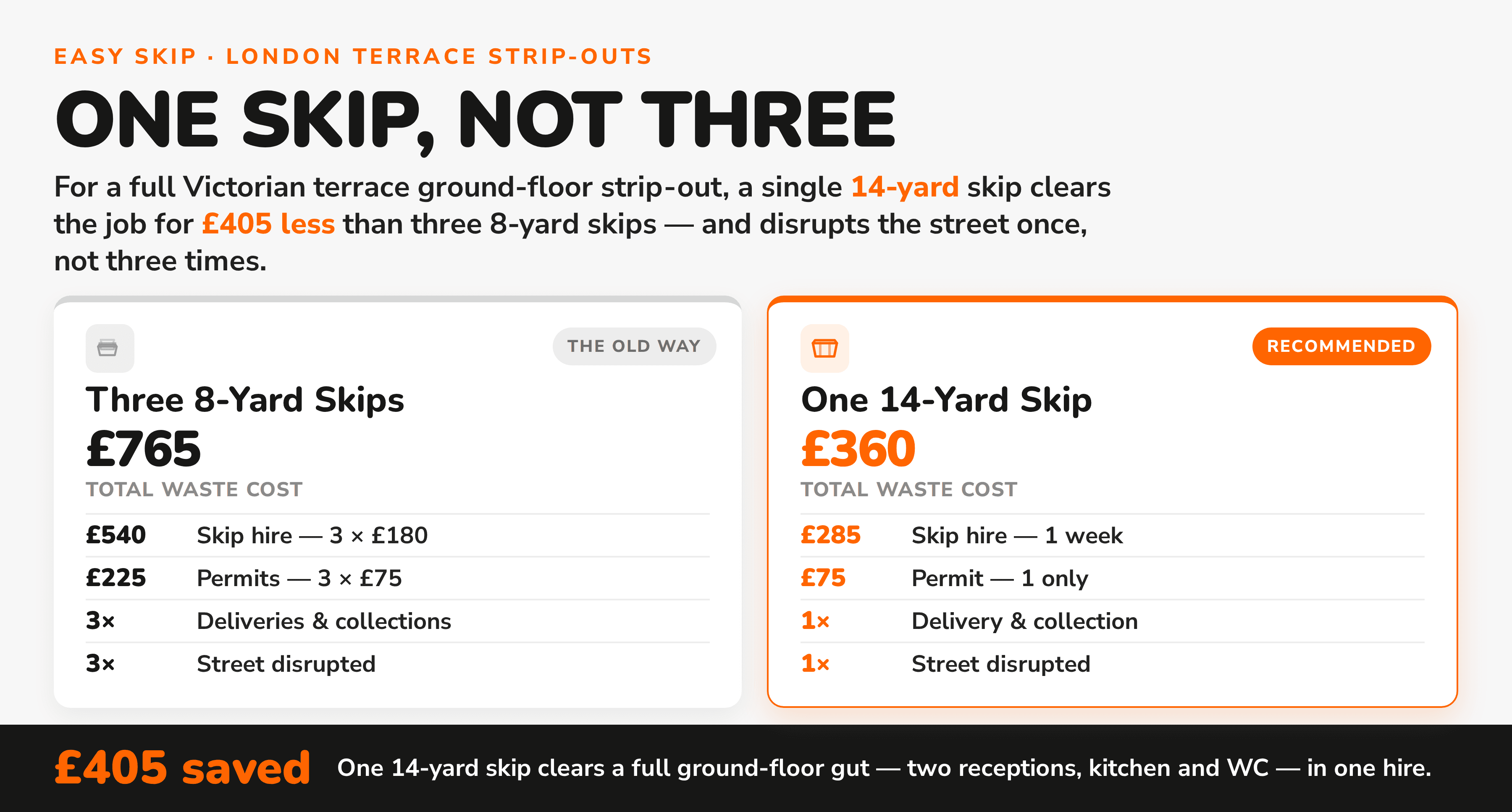
The economics work better than most contractors realise, especially once you factor in delivery charges and permit costs for multiple smaller skips. On a typical Victorian terrace renovation, I'd previously use three 8 yard skips across a six-week project.
Three 8 yard skips in Zone 2 London cost around £180 each, plus three separate permits at £75 each. Total waste management cost: £765, plus the hassle of coordinating three separate collections and dealing with neighbours who weren't happy about skips appearing outside their houses every fortnight.
One 14 yard skip costs approximately £285 for a week's hire, plus one permit at £75. You save £405 on a typical job, and you only disrupt the street once. The difference covers almost a full day's labour costs, which matters when you're pricing competitively. There's another saving most people miss. Skip companies often offer better rates for longer hire periods, and a single 14-day hire can work out cheaper per day than a 7-day rental.
Timing Your Strip-Out Phases
The single skip approach only works if you plan your demolition phases properly. You can't just hack everything out on day one and hope it fits.
I start with the kitchen, which typically generates the most awkward shapes. Units, worktops, and appliances go straight into the skip, along with any tiles or splashbacks that come off cleanly. The kitchen strip-out usually fills about 40% of the skip's volume.
Bathroom work comes next, and this is where careful planning matters. If there's a cast iron bath, I arrange for it to be disconnected and lifted out in one piece rather than breaking it up. Same with ceramic sanitaryware, which takes up less space intact than smashed into fragments.
Week 1: Kitchen strip-out and first fix electrical work
Week 2: Bathroom removal, old flooring throughout ground floor Final days: Plastering debris, packaging materials, and any remaining odds and ends
The plastering phase generates more waste than most people expect, especially if you're replastering over old horsehair plaster. I budget for roughly 15 large rubble sacks per room, though this varies depending on the condition of the existing walls.
Comparing Skip Sizes for London Renovations
I get asked regularly whether a 12 yard skip might be sufficient for a Victorian terrace renovation, especially on tighter budgets. The honest answer is that it depends on your tolerance for risk and your ability to manage waste streams carefully.
A 12 yard skip works for kitchen-only projects or bathroom-only renovations, but it's marginal for combined work. I've made it work on smaller terraces, particularly the narrow Victorian houses you find in areas like Rotherhithe, but you need to be ruthless about recycling and disposal elsewhere.
For a detailed comparison of when each size makes sense, the 12 yard vs 14 yard skip compared guide covers the capacity differences and cost implications better than I can explain in a few paragraphs here.
The extra capacity in a 14 yard skip gives you breathing room for the unexpected discoveries that come with Victorian houses. Hidden chimney breasts, random internal walls that turn out to be load-bearing, and the sort of creative plumbing arrangements that previous owners have cobbled together over the decades.
Driveway and Access Considerations
Most London terraces were built before cars existed, so front garden access is often impossible. Even where there's a front garden, the path width and gate openings usually won't accommodate skip delivery.
I measure access routes before confirming any booking. The delivery lorry needs at least 3 metres of road width to manoeuvre safely, plus overhead clearance of 4.5 metres for any overhanging branches or cables. Some of the narrower streets in areas like Kentish Town or around Oval simply can't accommodate the larger delivery vehicles.
For properties where driveway placement might be possible, there's a useful guide about 14 yard skip size and driveway fit that covers ground loading and surface protection requirements in more detail than I'll go into here.
The weight distribution matters more on private driveways than on public roads. A fully loaded 14 yard skip can weigh up to 11 tonnes, which will crack most domestic paving or damage soft ground. Skip companies provide wooden boards or steel plates to spread the load, but you need to request this when booking.
Managing Prohibited Materials
Victorian terraces often contain materials that can't go into general waste skips, and this affects your planning more than you'd think. Asbestos is the obvious concern, particularly in houses built or renovated between 1950 and 1980, but there are other restrictions that catch contractors out. Paint tins, even old empty ones, count as hazardous waste and need separate disposal. I've had skips rejected because painters had thrown old gloss paint tins in with general renovation debris. Same with cleaning solvents, white spirits, and the various chemicals that accumulate during refurbishment work.
Electrical items need separate disposal under WEEE regulations. This includes old boilers, immersion heaters, and electric storage radiators, plus smaller items like extractor fans and light fittings. Some skip companies will accept these mixed with general waste, others won't. Worth checking when you book.
Plasterboard disposal has become more complicated since the Environment Act 2021 came into force. Some skip companies now charge extra for plasterboard or require it to be separated, while others include it in standard mixed waste pricing. The rules vary by disposal facility, which makes it hard to predict costs accurately.
I keep a separate collection area for prohibited items during any renovation. Usually just a corner of the room where paint tins, electrical waste, and anything containing asbestos gets stored until I can arrange proper disposal.
Real Costs from Recent London Jobs
The Dulwich job I mentioned cost £285 for 14 days' 14 yard skip plus £75 for the Southwark Council permit. We filled it completely with kitchen units, bathroom fittings, old floorboards from three rooms, and approximately 40 bags of mixed plaster and tile debris.
A more recent job in Clapham came to £310 for the skip (prices have risen since 2019) plus £85 for Wandsworth's permit. This was a larger house with a cast iron bath, range cooker, and extensive tile removal from two bathrooms. The skip was collected at 94% capacity on day 12 of a 14-day hire.
Compare this with a job I did in Hackney where the client insisted on using multiple smaller skips. Two 8 yard skips cost £360 plus £130 in permits, and we still needed a third skip for unexpected waste when we discovered a bricked-up fireplace during the kitchen work. Total cost £735. The savings are real, but they depend on managing the project properly. You can't just book a big skip and hope for the best.
Companies like easyskip.uk have made the booking process simpler than it used to be, with online scheduling and clear pricing that includes delivery and collection. But the fundamental challenge remains the same: fitting everything from a London terrace renovation waste project into one container without exceeding weight limits or mixing prohibited materials with general waste.
Next time you're pricing a Victorian terrace renovation, calculate the total cost of multiple small skips versus one large one. Include permit fees, delivery charges, and the time cost of managing multiple collections. The numbers might surprise you enough to change how you approach waste management on your next London project.