


Skip Hire Glasgow Gets Complicated as Scotland Bans Biodegradable Waste from Landfill
Sarah Baker• 12.10.2026

How new regulations are reshaping waste disposal across the central belt
I was standing in our Paisley yard on a Tuesday morning in September 2023, watching my driver Colin load up a skip that had come back from a Bearsden house clearance. The homeowner had called to complain that we'd charged an extra £89 for "alternative disposal", and I'd have to explain Scotland's biodegradable waste rules all over again. Most folk still don't realise how much changed when the Scottish Government brought in its Scotland landfill ban on biodegradable municipal waste Scotland sends to tips.
The skip was a right mess. Garden waste mixed with kitchen scraps, old clothes bundled with newspapers, and what looked like the contents of someone's loft scattered on top. Under the old system, the whole lot would've gone straight to landfill after we'd pulled out anything obviously recyclable. Now I had to tell this customer why their bill was higher than their neighbour's identical job from six months earlier.
That's when 8 yard skip hire Glasgow bookings started getting more complicated for everyone. The regulations mean we can't just tip biodegradable material into Scottish landfills anymore, so jobs that used to be straightforward now need proper sorting. I've been running skips around Glasgow and the surrounding areas for eleven years, and I've never seen a rule change affect pricing quite like this one.
What Scotland's Biodegradable Waste Ban Actually Means
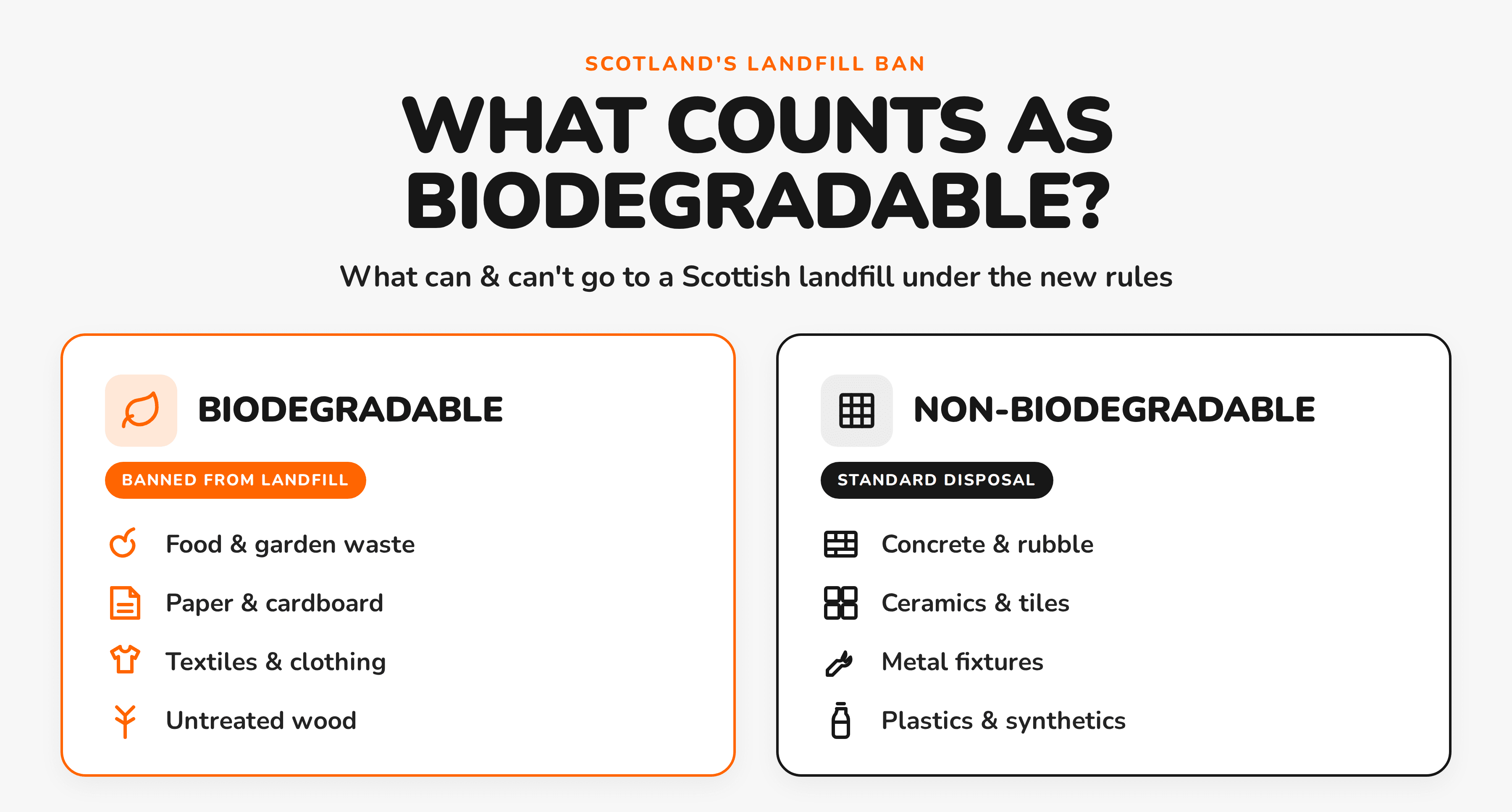
The ban covers any organic material that'll rot down naturally. Food scraps, garden cuttings, paper, cardboard, textiles, and untreated wood all count as biodegradable under Scottish Environmental Protection Agency guidelines. If it would break down in a compost heap given enough time, it can't go to Scottish landfills anymore.
I learned this the hard way when we got a fine in October 2023. One of our regular commercial clients in Clydebank had mixed office waste with canteen leftovers, and the landfill site's spot check caught us. The £340 penalty wasn't just about the money, though that stung. It was the paperwork afterwards and the extra training we had to put our drivers through.
The rules apply differently depending on what type of waste you're dealing with:
Household mixed waste gets sorted at transfer stations before the biodegradable bits go to energy recovery or composting facilities
Garden waste and food scraps need separating at source or they'll push your skip into the higher-cost disposal route
Commercial clients face stricter requirements and need waste transfer notes that specify exactly what's going where
How Skip Prices Changed Across Glasgow
Before the ban, I could quote a flat rate for most residential jobs. An 8-yard skip for a kitchen renovation in Merchant City cost the same whether it contained just rubble or a mix of old cupboards, food packaging, and garden waste from the back court.
Now I have to ask more questions upfront. Last month, a customer in Dennistoun wanted to clear their entire flat after a bereavement. Mixed household contents, books, clothing, and leftover food from the kitchen. Under the new system, that job cost £167 more than the same skip filled purely with construction waste would have done. The biodegradable content had to go through a materials recovery facility first, then on to different end destinations.
The price difference isn't just our markup. Alternative disposal routes genuinely cost more:
Energy recovery facilities charge gate fees that exceed standard landfill rates
Organic waste processing requires additional transport to specialist sites, often outside the Glasgow area
Transfer stations add handling costs when they separate mixed loads before onward processing
Compliance documentation and tracking systems increase our administrative overhead
Some materials need pre-treatment before they qualify for energy recovery or composting
What This Means for Common Glasgow Skip Jobs
House clearances hit the biggest price increases. I did one in Partick last November where the customer had sorted everything themselves. Clothes and books in one pile, furniture and carpets in another, garden waste bagged separately. That organisation saved them £134 compared to throwing everything together and letting us sort it later.
Kitchen and bathroom renovations stayed more predictable. Ceramic tiles, metal pipes, and concrete don't count as biodegradable, so those jobs price up the same as before. But if you're replacing wooden kitchen units or clearing out old wallpaper and cardboard packaging, expect higher costs.
Garden clearances became particularly tricky to price. A customer in Hillhead called for a quote to clear their back garden after storm damage in February 2024. Trees, shrubs, soil, and broken wooden fencing. All of it biodegradable under the regulations, so none of it could go to standard landfill. The job ended up costing 43% more than the same volume of construction rubble.
How Waste Gets Processed Under the New Rules
I used to think I understood what happens to your skip waste after we collected it, but the new regulations opened my eyes to how complex the sorting and processing actually gets. Most loads now go through at least two facilities before reaching their final destination.
Our local transfer station in Shieldhall upgraded their equipment in early 2024. They installed new conveyor systems and hired additional staff to hand-pick biodegradable materials from mixed loads. The manager there told me they're processing 28% more tonnage than before the ban, but sending 61% less material to landfill sites.
Energy recovery became the main destination for separated biodegradable waste. The facility at Dunbar takes loads from across the central belt, but transport costs add up when you're moving materials that far. Some organic waste goes to in-vessel composting sites, but capacity remains limited and the process takes longer than traditional landfill disposal.
Why Most Skips Still Cost More Than Expected
The reality gap between regulations and daily practice creates most of the confusion I see with customers. People read about recycling rates and assume their skip contents will get sorted for free, but someone has to pay for all that additional handling. This connects to broader issues around why most UK skips still end up in landfill despite Scotland's stricter biodegradable waste rules.
Even with the ban, plenty of non-biodegradable skip contents still go to landfill. Broken concrete, ceramic bathroom suites, metal fixtures, and synthetic materials don't fall under the regulations. The difference is that mixed loads now require sorting before disposal, and that sorting costs money whether the end destination is landfill, energy recovery, or recycling.
I misjudged this completely when the rules first came in. Thought customers would adapt quickly and start separating waste themselves to avoid higher charges. Instead, most people still fill skips the same way they always did. They want convenience, and they're willing to pay extra for it rather than spend hours sorting through their waste.
Regional Differences Around Scotland
Glasgow's situation differs from other Scottish cities because of our transfer station capacity and transport links. Edinburgh has better rail connections for moving waste to processing facilities, which keeps their disposal costs lower than ours. Aberdeen's distance from major energy recovery plants pushes their alternative disposal fees higher than anything we see in the central belt.
The Highlands face the biggest challenges. A colleague who runs skips around Inverness told me his biodegradable waste disposal costs doubled after the ban. Transport distances to compliant facilities make small jobs uneconomical, so many Highland operators now require minimum loads or longer booking periods to make the numbers work.
Practical Changes for Skip Hire Customers
Separating waste at source saves the most money, but it requires more planning than most people expect. I tell customers to keep three areas: one for definitely biodegradable materials, one for obviously non-biodegradable waste like concrete and metal, and one for anything they're unsure about.
Timing became more important too. Mixed loads take longer to process, so collections scheduled for busy periods might get delayed. I had to reschedule four pickups in December 2023 because the transfer station couldn't handle the volume of pre-Christmas clearances that needed sorting.
Some customers switched to smaller, more frequent skips rather than one large mixed load. A Southside landlord I work with now books two separate skips for major refurbishments. One for construction waste that can go straight to landfill, another for anything organic that needs alternative processing. The separate bookings cost him £56 more overall, but he gets faster turnaround and more predictable pricing.
Check what your local skip hire Glasgow company includes in their standard rates versus their biodegradable waste surcharges. Some operators like easyskip.uk build the additional processing costs into their base prices, while others charge separately for mixed loads that need sorting. Ask specifically about their policy before you book, and get the pricing structure in writing if you're planning a large clearance project.