


8 Yard Skip Hire Liverpool: Terrace Makeovers in Anfield, Walton and Wavertree
Sarah Baker• 10.10.2026

What Really Fits When You're Gutting a Victorian Terrace
I was standing in a stripped-out front room in Walton on a Tuesday morning in March 2019, looking at a pile of rubble that had once been a chimney breast. The homeowner had been convinced an 8-yard skip would be plenty for their kitchen extension and front room knockthrough. By 11:30am, I could see they'd made the same mistake I'd watched dozens of other terrace owners make.
The problem with Liverpool terraces isn't the size of the rooms. It's what's hidden behind the walls once you start pulling them apart. That morning, we'd already filled half the skip with just the chimney breast debris, three bags of old plaster, and a stack of floorboards from upstairs where they'd opened up the ceiling.
When you're planning a terrace renovation in areas like Anfield, Walton or Wavertree, getting 8 yard skip hire Liverpool sorted early makes sense. But you need to know exactly what you're dealing with before that yellow skip lands on your street.
Why Victorian Terraces Generate More Waste Than You'd Think
I've cleared out dozens of these houses over the past eight years, and they're deceptive. A two-up, two-down looks manageable from the outside, but once you start stripping wallpaper, lifting floorboards and knocking through walls, the waste adds up fast. Take that job in Walton. We'd planned for:
Kitchen units and worktops
Bathroom suite and tiles
Kitchen units and worktops
Carpet and underlay from three rooms
General household clearance
Some plaster and a bit of timber from the knockthrough
What we actually pulled out was twice that volume. The kitchen had been extended into a back addition sometime in the 1960s, and the floor was a mix of concrete, old quarry tiles, and a layer of cork tiles on top. The bathroom had been tiled three times over, each layer stuck on top of the last. And the knockthrough? That chimney breast was solid engineering brick, not the hollow modern stuff.
By Thursday afternoon, we'd filled the 8-yard skip and still had a spare bedroom full of bagged waste waiting to go. The homeowner had to book a second skip, which cost them an extra £180 plus a three-day wait.
What Actually Fits in an 8 Yard Skip During a Terrace Renovation
The honest answer depends on your renovation scope, but I've learned to work backwards from what definitely won't fit. An 8-yard skip measures roughly 12 feet by 6 feet by 4 feet high. That sounds like plenty until you start loading it with the dense, heavy waste that comes out of old terraces.
For a typical Liverpool terrace renovation, you're looking at:
A full bathroom suite with pedestal sink, toilet and cast iron bath (that's about a quarter of your skip gone)
Kitchen units from a standard galley kitchen, but not if they include granite or stone worktops
The weight becomes an issue before the volume does. I once watched a homeowner in Wavertree load their skip with rubble from a knocked-through wall between their living room and dining room. The skip was only half full by height, but it hit the 10-tonne weight limit and couldn't be collected. They had to pay £75 to have some of the rubble removed before the lorry could lift it.
Understanding what fits in an 8 yard skip becomes crucial when you're working with the dense materials you find in Victorian terraces.
The Hidden Waste in Liverpool Terrace Renovations
Every terrace renovation I've worked on has produced unexpected waste. It's rarely the obvious stuff that catches people out.
In Anfield last summer, we were renovating a house that looked standard from the street. Two bedrooms, one reception room, kitchen and bathroom. The owner had budgeted for normal household waste plus some plaster and old kitchen units. What we found was different.
The previous owners had been enthusiastic DIYers. Behind the kitchen units, we discovered they'd tiled the entire wall with thick ceramic tiles, then tiled over those tiles, then painted over the lot. The bathroom had three layers of vinyl flooring, each glued down separately. The bedroom ceilings had been lowered with a false ceiling that was packed with old fibreglass insulation.
None of this was visible until we started the renovation. By the end of week two, we'd filled one 8-yard skip with just the bathroom and kitchen waste. The bedroom clearance needed a second skip.
Planning Your Skip Size for Different Types of Terrace Work
I've learned to ask specific questions before recommending skip hire Liverpool services to terrace owners. The work type matters more than the room count. Kitchen and bathroom replacements usually fit in an 8-yard skip if you're not moving walls. You're looking at units, appliances, tiles, a bit of plaster where you've chased pipes, and flooring. But add any structural work and you'll need more capacity.
Full house clearances are different again. I cleared a three-bedroom terrace in Wavertree in 2021 where the elderly owner had kept everything for sixty years. Furniture, clothes, books, kitchen equipment, garden tools, decades of newspapers. It looked like it would need two skips, but because household items are lighter and compress well, it all fitted in one 8-yard skip with room to spare. The trick was loading it properly, breaking down furniture and filling gaps with smaller items.
Weight Limits and Dense Materials
This is where most Liverpool terrace renovations go wrong with 8 yard skip hire . The volume looks manageable, but Victorian building materials are heavy.
I learned this lesson the expensive way on a job in Walton three years ago. We were renovating a mid-terrace house where the owner wanted to remove a load-bearing wall between the front and back reception rooms. The wall was 9 inches thick, solid brick, about 12 feet long and 8 feet high. I estimated it would take up about half an 8-yard skip.
The bricks alone weighed close to 8 tonnes. Add the concrete lintel, some old plaster, and a few bags of general renovation waste, and we hit the skip's 10-tonne weight limit before it was two-thirds full by volume. The skip company couldn't collect it until we'd removed about a tonne of bricks by hand and loaded them into a trailer.
Since then, I always warn people about mixing rubble with other renovation waste. If you're knocking down walls, that rubble needs its own skip or you need to upgrade to a larger size that can handle more weight.
Permit Requirements for Liverpool Streets
Getting an 8-yard skip onto the street outside your terrace isn't always straightforward in Liverpool. Most of the terraced areas in Anfield, Walton and Wavertree have narrow roads with cars parked on both sides.
You need a permit from Liverpool City Council if the skip goes on the public highway, which includes the road and usually the pavement. The permit costs £26 for up to 14 days, and you need to apply at least five working days in advance. But the practical challenge is space.
I've seen skips delivered to terraced streets where there simply wasn't room to place them safely. The lorry driver took one look at a street in Wavertree last autumn, cars parked solid on both sides with maybe 6 feet of road width left in the middle, and refused to drop the skip. The homeowner had to arrange with neighbours to move cars, then re-book the delivery for the following week.
On some streets, you're better off finding a way to fit the skip on your property, even if it means sacrificing part of a small front garden or yard. It saves the permit fee and the hassle of coordinating with neighbours and traffic.
What You Can't Put in Your Liverpool Skip
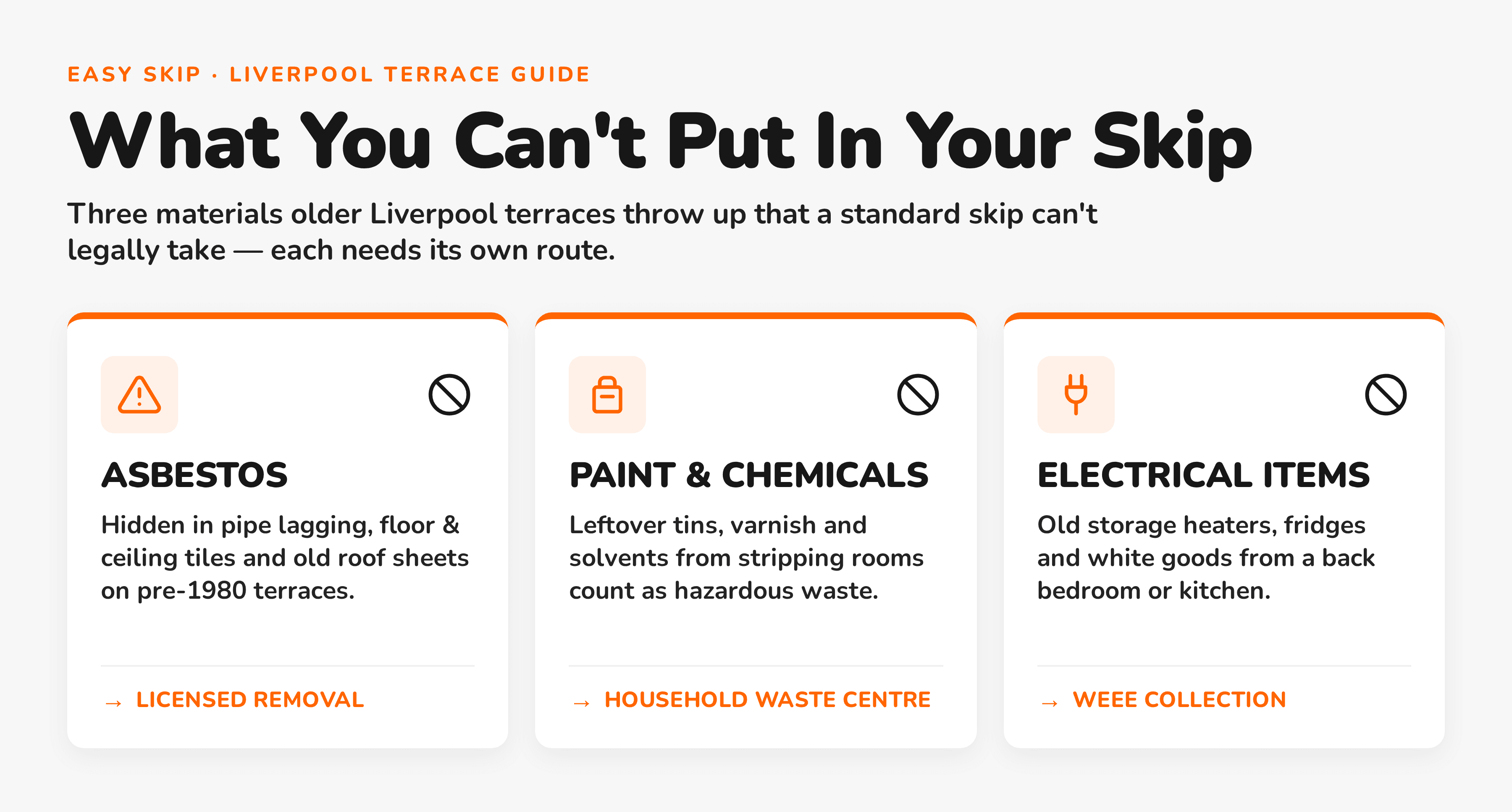
The restrictions matter more during terrace renovations because older houses contain materials you can't put in a standard skip. I've had to explain this to homeowners who assumed everything from their renovation could go in one place. Asbestos is the big one. Any terrace built before 1980 might have asbestos in pipe lagging, floor tiles, ceiling tiles, or roof sheets. You can't put this in a normal skip. It needs specialist disposal, which costs around £400-600 for a typical domestic amount.
Paint tins are another issue. If you're stripping multiple rooms, you'll accumulate tins of old paint and varnish. These count as hazardous waste and can't go in the skip. Liverpool has household waste recycling centres that take them for free, but you have to transport them yourself.
Electrical items are also restricted. That old storage heater from the back bedroom, the ancient fridge from the kitchen, the broken washing machine, all of these need separate disposal through WEEE recycling schemes.
Making an 8 Yard Skip Work for Your Liverpool Terrace
The key is loading strategy and knowing when to stop. 8 yard skip - the practical all-rounder works well for most terrace renovations if you're realistic about what goes in it.
Load heavy items first. Bathroom suites, kitchen units, any rubble or building waste. These sit in the bottom and create a solid base. Then fill the gaps with lighter items, bags of old clothes, carpet offcuts, packaging from new fixtures.
Don't overfill it. I've seen homeowners pile waste 2 feet above the skip sides, thinking the lorry will compress it during collection. It doesn't work that way. If waste is above the skip rim, many companies won't collect it for safety reasons. You'll pay a surcharge to have the excess removed, usually around £50.
Break things down where possible. Furniture disassembles, long timbers can be cut shorter, cardboard boxes flatten. The more you break down, the more you fit.
Services like easyskip.uk handle most of Liverpool and can usually deliver within a day or two if you're not too fussy about timing. Their 8-yard skips work for most terrace jobs I've seen, though I always tell people to be conservative in their estimates.
If you're planning a Liverpool terrace renovation that involves structural work, order your skip after you've started the job and can see what's actually coming out of the walls. That Tuesday morning in Walton taught me that Victorian terraces never give up their secrets until you start taking them apart.