


16 Yard Skip Hire Glasgow: When Shopfitting Strip-Outs Go Wrong
David Doe• 17.11.2026

What I learned from three botched retail clearances on Scotland's busiest shopping streets
I've been managing strip-outs for retail refits across Glasgow for eleven years now, and I still remember the Wednesday morning in March 2019 when I watched £340 worth of skip hire turn into a £1,890 headache on Buchanan Street. The shop was a former phone retailer, squeezed between two fashion chains, and we'd booked what I thought was plenty of capacity for a straightforward clearance.
The problems started before 9am. Our first mistake was underestimating just how much timber framework and plasterboard comes out of a modern shopfit. What looks like a clean, minimal retail space from the customer side often hides a maze of stud walls, false ceilings, and cable runs that previous contractors have built up over the years.
That's when I learned why 16 yard skip hire Glasgow bookings need more planning than you'd think. The 16 yard skip we'd ordered was sitting outside the shop by 7:30am, but by lunchtime we'd filled it completely and still had two-thirds of the strip-out left to do.
The Real Volume of Shopfitting Waste
Most people think retail units are just hollow boxes with some shelving and a till point. I used to think the same thing. But pull apart a typical high street shop and you'll find layers of previous fit-outs that nobody bothered to remove properly.
That Buchanan Street job taught me to expect these materials on every Glasgow shopfitting waste clearance:
MDF shelving units, often custom-built and surprisingly heavy when you're loading them into skips
Chipboard flooring that's been screwed down through multiple layers
Plasterboard partition walls, sometimes three or four sets from different shop layouts over the years
Metal display fixtures that don't break down as small as you'd hope
Ceiling tiles, suspended grid systems, and enough fluorescent light fittings to illuminate a warehouse
The timber alone from that phone shop filled 8 cubic yards of our skip. And that was after we'd broken down everything we could with crowbars and reciprocating saws.
Why Standard Skip Sizes Don't Match Retail Reality
Here's what nobody tells you about commercial skip hire Glasgow for shopfitting work. The industry talks about skip sizes in yards, but they mean cubic yards of loose-loaded waste. When you're stripping out fitted retail space, nothing loads loose.
Shelving units are awkward shapes that waste space in the skip. Plasterboard sheets don't break cleanly, so you end up with long pieces that bridge across the top of the skip. Metal display rails create voids underneath them that you can't fill efficiently.
I measured our loading efficiency on that Buchanan Street job and found we were getting maybe 60% of the theoretical capacity. A 16 yard skip was giving us closer to 10 yards of usable space for the bulky materials we were dealing with.
The shop next door was getting refitted the same week. Their contractor had ordered two 12-yard skips instead of one large one, and they finished the job without any extra collections.
Permit Problems on Sauchiehall Street
Six months later, I was managing a strip-out for a former shoe shop on Sauchiehall Street when we ran into a different kind of problem. The council permit we'd arranged covered one skip for five working days, but we needed to swap out a full skip on day three of the job.
Glasgow City Council treats each skip as a separate permit application, even when it's the same bay on the same job. Our skip supplier had to apply for a new permit for the replacement skip, which meant a 48-hour delay while the paperwork went through. The shop was left half-stripped with materials piled inside because we couldn't put them anywhere else.
That delay cost us £420 in extended labour charges, plus the landlord started asking questions about why we were behind schedule. The whole thing could have been avoided if we'd applied for permits to cover multiple skips from the start, but nobody had explained that to us.
Loading Strategies That Actually Work
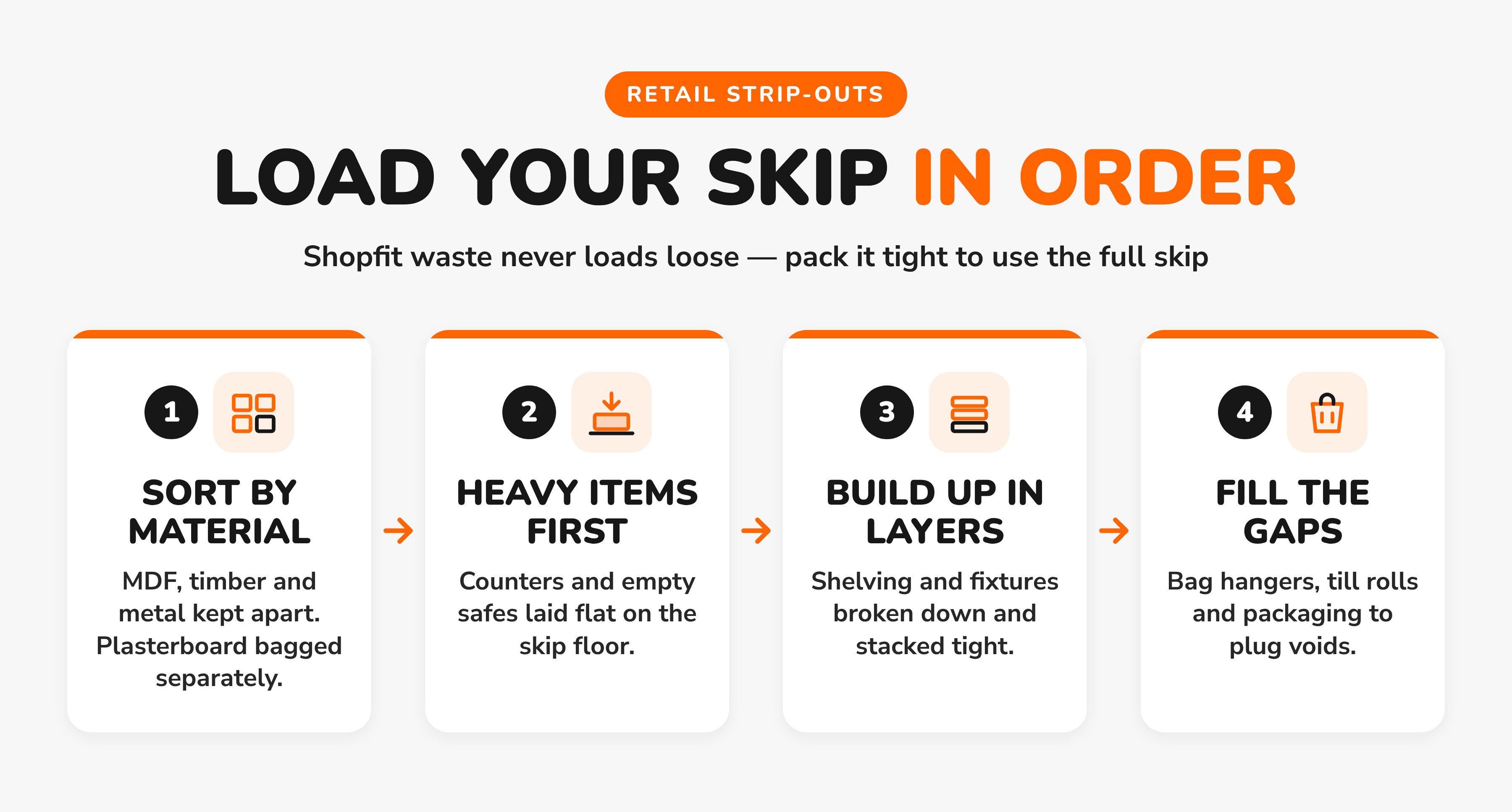
After those early mistakes, I developed a system for maximising space in Glasgow shopfitting waste containers. It's not just about breaking everything down smaller, though that helps.
First, I separate materials by type during the strip-out instead of mixing everything together. MDF and chipboard go to one side of the skip, metal fixtures to another, and plasterboard gets loaded in manageable sections. This alone improved our loading efficiency by about 25%.
Second, we load systematically rather than just throwing things in. Heavy materials like old safes and display counters go in first, flat against the bottom. Then we build up with the bulky but lighter items, using smaller pieces to fill gaps as we go.
The trick with retail strip-outs is that you often get a lot of small items mixed in with the big structural pieces. Till rolls, hangers, price labels, packaging, and all the everyday detritus of running a shop. If you bag these small items properly, they become useful void-fillers around the larger pieces.
What the Hire Companies Don't Tell You
Most commercial skip hire Glasgow companies will happily book you a 16 yard skip for shopfitting work without asking detailed questions about what you're clearing. They assume you know what you need, and they're not wrong to assume that, but they could save everyone a lot of trouble by explaining how retail waste behaves differently from general building waste.
I've learned to ask specific questions when I'm booking skips now. How much shelving are we removing? Is there a suspended ceiling? Are there partition walls, and if so, how many layers? The answers help me decide whether to book one large skip or multiple smaller ones.
There's also the question of contamination, which several companies have mentioned to me over the years. Retail spaces often contain materials that can't go in a standard mixed waste skip. hidden costs facility managers miss often include separate collections for things like fluorescent tubes, computer equipment, or chemical products left behind by the previous tenant.
Timing Your Collections
Glasgow's main shopping streets have their own rhythms that affect when you can position and collect skips. Buchanan Street gets busy with pedestrians from about 10am onwards, and parking enforcement is strict. Sauchiehall Street has similar patterns but with different peak times.
I've found the best collection times are either before 8am or after 6pm, when foot traffic is lighter and you're less likely to block other deliveries. But that means coordinating with skip companies whose drivers prefer to work normal hours, and some firms charge extra for early or late collections.
The other timing issue is how long strip-out work actually takes. Retail units often look straightforward from outside, but once you start pulling apart built-in fixtures and dealing with services that weren't properly documented, a two-day job can easily stretch to four days. I always book skip hire for at least 50% longer than my initial estimate now.
Different Skip Types for Different Jobs
Not all retail clearances need the same approach to waste management. A small independent shop that's been trading for decades will generate different waste from a chain store that gets refitted every few years.
Independent shops tend to accumulate more miscellaneous items over time, and their fittings are often bespoke or adapted from whatever was available when they first opened. Chain stores usually have standardised fixtures that come apart more predictably, but they might have specialised display systems or security installations that create their own disposal challenges.
The difference between commercial vs residential skips becomes important here too. Residential skip hire often comes with more flexible timing and fewer permit complications, but the weight limits and prohibited items lists can be stricter because the vehicles and processing facilities are set up differently.
What I'd Do Differently Now
Looking back at those early jobs, I'd budget differently for skip hire from the start. Instead of calculating based on the visible shop fittings, I'd allow for at least twice as much waste as I could see, plus contingency for permit extensions or additional collections.
I'd also visit the site at different times of day before booking anything. That Sauchiehall Street job would have gone much smoother if I'd realized how narrow the loading bay was during busy periods, and how that would affect our ability to load skips efficiently.
The biggest change would be building better relationships with the skip suppliers. Companies like easyskip.uk have handled enough retail clearances to give useful advice about sizing and timing, but only if you explain exactly what kind of strip-out you're planning.
These days, I always ask for a site visit before confirming the skip size, especially for jobs on busy streets where access or permits might be complicated. It takes an extra day of planning, but it's saved me from repeating those expensive mistakes from 2019.