


14 Yard Skip Hire: Why It Has Become the Default Choice for Furniture-Heavy House Clearances
David Doe• 13.11.2026

How one skip size conquered the messiest job in waste management
I'd been running house clearances across Staffordshire for eleven years when I finally admitted I'd been getting the skip sizes wrong. It was a Tuesday morning in March 2019, standing in a three-bedroom semi in Stafford, looking at a dining table that wouldn't fit through the front door in one piece. The 12-yard skip outside was already three-quarters full, and we hadn't even started on the upstairs furniture.
That job taught me something every clearance contractor learns eventually. Furniture doesn't pack like rubble or garden waste. A sofa takes up the same space whether it's whole or dismantled, and you can't crush a wardrobe down to fit more in. The physics are unforgiving, and I'd spent too many jobs hiring a second skip halfway through because I'd underestimated the bulk.
These days, I book 14 yard skip hire for any clearance that involves more than a bedroom's worth of furniture. It's become my standard approach, and I'm not alone in that. Most clearance specialists I know have made the same shift over the past five years. The 14-yard has quietly become the workhorse of the furniture clearance skip world.
The Furniture Problem That Changed Everything
Furniture has got bigger since I started this work. Not just the obvious stuff like American-style fridges and corner sofas, but everything. Kitchen islands, walk-in wardrobes, dining tables that seat ten people. And it's not just size. Modern furniture often comes with mixed materials that make disposal complicated.
I cleared a house in Cannock last October where the master bedroom had a built-in wardrobe system with metal rails, wooden panels, and plastic drawer units. Dismantling it filled 3.2 cubic metres on its own. Add the king-size bed, two bedside cabinets, and a dressing table, and you're looking at nearly half a 14-yard skip for one room.
The old rule of thumb was simple:
6-yard skip for a one-bedroom flat
8-yard skip for a two-bedroom house
12-yard skip for anything bigger
But furniture doesn't follow property sizes anymore. I've seen studio flats with more furniture volume than some three-bedroom houses from the 1960s.
Why 14 Yards Works for Modern Clearances
The 14 yard skip gives you room to work badly and still finish the job. That sounds like poor planning, but it's actually practical sense. House clearances rarely go to plan. You find things you didn't expect, or the family changes their mind about what they're keeping, or something breaks during removal and takes up twice the space.
I remember a job in Lichfield where we were halfway through loading when the client decided they wanted to keep the dining room suite after all. With a 12-yard skip, that would have meant reorganising everything we'd already loaded. With a 14-yard, we just adjusted and carried on.
The extra 2 cubic yards also matters for the awkward shapes that furniture creates. A three-piece suite doesn't stack neatly like building waste. You get gaps and voids that you can't fill efficiently, and those dead spaces add up quickly in a smaller skip.
The Real Cost of Getting Skip Size Wrong
Getting the house clearance skip size wrong costs you in ways that aren't obvious until it happens. The obvious cost is hiring a second skip, which usually means paying for two deliveries, two collections, and two permits if you need them. On a recent job, that mistake cost me an extra £287 because I had to get a second 8-yard skip delivered the next day.
But there are hidden costs too. Your team loses momentum when they have to stop loading and wait for more capacity. The client gets frustrated watching half-dismantled furniture sitting in their hallway overnight. And you lose credibility when you have to explain why you didn't anticipate the volume properly.
The time cost is often the worst part. I once spent six hours of a Friday afternoon transferring items between skips because I'd filled the first one with the wrong things. That's billable time lost, and Friday afternoon isn't when you want to be playing skip Tetris in someone's driveway.
How Furniture Volume Really Works
People think dismantling furniture saves significant space, but it often doesn't. Take a standard dining table with six chairs. Whole, it might measure 180cm by 90cm by 75cm. Dismantled, you've still got the same volume of wood, metal, and fabric, just in different shaped pieces. The only real space saving comes from nesting chairs or folding legs flat against table tops. But most furniture isn't designed to pack efficiently. Modern sofas have sprung bases that don't compress, and MDF panels from flat-pack furniture often split when you dismantle them, creating sharp edges that waste space in the skip.
I've learned to estimate furniture volume by room rather than by piece count:
Living room with three-piece suite and storage units: 4-5 cubic yards
Master bedroom with fitted wardrobes: 3-4 cubic yards
Kitchen with all units and appliances: 5-7 cubic yards
Dining room with table, chairs, and sideboard: 2-3 cubic yards
Home office or spare bedroom: 1-2 cubic yards
Those numbers assume you're clearing everything, not cherry-picking individual items.
The Loading Strategy That Actually Works
Loading a 14 yard skip for furniture clearance isn't the same as loading it for building waste. With rubble or timber, you can fill from one end and work your way across. With furniture, you need to think in three dimensions from the start.
Heavy items go in first, but not necessarily at the bottom. Sofas and mattresses are light but bulky, so they often go in the middle layers where you can build around them. Wardrobes and bookcases create vertical spaces that you can stuff with smaller items like chairs and coffee tables.
The trick is leaving gaps you can use later. I always put dining tables in at an angle, creating triangular spaces underneath for bags of clothes or small electrical items. And I never fill the corners completely until the end, because that's where oddly shaped items like lamp stands and plant pots end up fitting best.
When 14 Yards Isn't Enough
There are still jobs where even a 14 yard skip won't cut it. Full house clearances of large properties, especially if they include garden furniture, workshop contents, or garage clearances alongside the indoor furniture. I did a five-bedroom house in Burton-upon-Trent last summer that needed two 14-yard skips, one primarily for furniture and household items, another for garden and garage contents.
Period properties with heavy, solid wood furniture can also exceed a 14-yard capacity. Victorian sideboards, mahogany wardrobes, cast-iron bed frames. The weight becomes an issue before the volume does, and you're looking at 16-yard or 20-yard territory.
But for most standard house clearances, the 14 yard skip has become the sweet spot. It handles the furniture volume of a typical three or four-bedroom property while giving you buffer space for the unexpected items that always turn up.
The Permit and Access Reality
One reason 14-yard skips work well for clearances is that they're still manageable for residential access. They fit on most driveways without overhanging the pavement, which saves you the permit hassle and the £43 daily fee that our local council charges for highway placement.
I check the 14 yard skip complete sizing guide with clients before booking, because there's nothing worse than a skip arriving that won't fit where you expected. The standard 14-yard measures roughly 4.3 metres long by 1.8 metres wide, so you need at least 5 metres of clear access to position it safely.
Terraced streets are often the problem. Victorian terraces typically have tiny front gardens, and parking a 14-yard skip means blocking part of the road. But most councils are reasonable about short-term permits for house clearances, especially if you book in advance and can show you're clearing a bereavement property.
What the Numbers Really Tell You
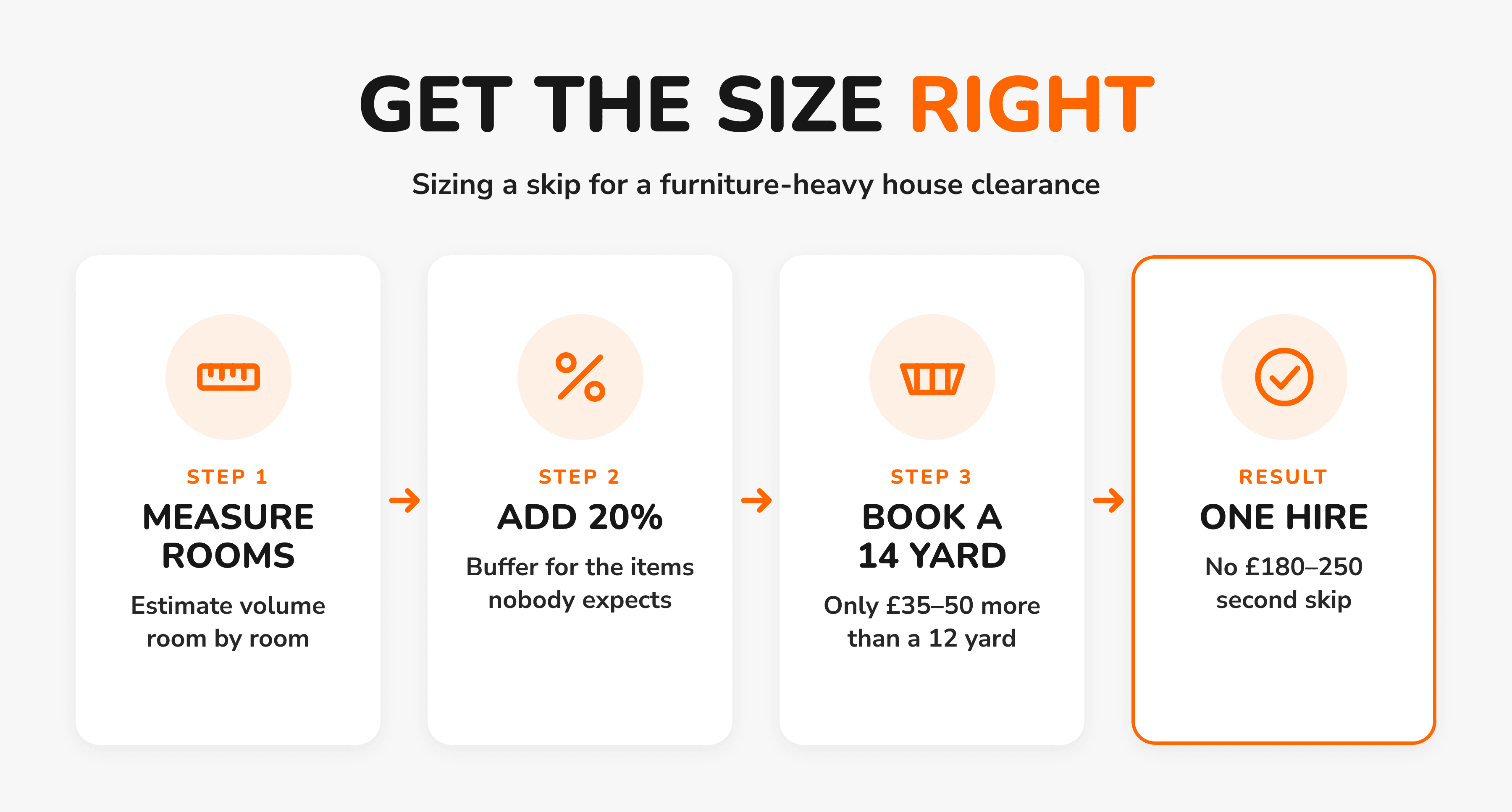
When I look at the invoices from the past two years, the pattern is clear. Before 2022, about 40% of my clearance jobs needed a second skip or an additional collection. Since switching to 14-yard as standard, that's dropped to about 15%. Most of those remaining problems are jobs where the client changed the scope halfway through, not genuine sizing errors.
The cost difference between a 12-yard and a 14-yard skip is typically £35-50, depending on your location and supplier. Compare that to the £180-250 you'll pay for a second skip if you get the sizing wrong, and the economics are straightforward. I'd rather overestimate slightly and finish the job in one go than save £40 upfront and risk doubling my costs.
I've started recommending sites like easyskip.uk to clients who want to handle their own clearances, because they're transparent about sizing and don't try to upsell you to bigger skips than you need. But they also don't undersell, which matters more for furniture jobs than most people realise.
The real 14 yard skip prices vary more than you'd expect across different areas, partly because of disposal costs for mixed household waste, partly because of permit requirements. In my area, you're looking at £280-320 for a standard 14-day hire, assuming you're not putting in anything that needs special handling.
Next time you're pricing up a furniture clearance skip , measure the rooms you're clearing and add 20% for the unexpected items. Most people underestimate how much space furniture actually takes up when it's loaded loosely into a skip, and that mistake costs more than the extra skip capacity ever will.