


10 Yard Skip Hire Derby: How Small East Midlands Builders Keep Sites Moving With Smart Skip Exchanges
David Doe• 12.11.2026

Why Derby's small builders are mastering the art of skip rotation to keep projects on schedule
I remember standing in a customer's drive in Mickleover on a Tuesday morning in November 2022, watching two of my regulars argue over who'd booked the skip first. Both were small builders, both had jobs running behind schedule, and both needed that 10 yard skip hire space desperately. The skip I'd delivered the day before was already three-quarters full of kitchen units and old plasterboard.
That's when I realised something had shifted in how Derby's smaller building firms were working. They weren't just hiring skips anymore. They were orchestrating exchanges. The 10 yard skip hire Derby market had become a carefully timed dance, with builders swapping out full skips for empty ones sometimes twice in a single day. I'd been driving skips around Derbyshire for eleven years, but this level of coordination was new to me.
The Problem That Changed Everything
Small builders in Derby face a problem that the big contractors don't. Limited site space. A terraced house renovation in Normanton doesn't have room for three skips lined up like dominoes. Neither does a kitchen extension in Allestree, where parking's already tight and neighbours get twitchy about disruption.
I learned this the hard way in early 2021 when I delivered a second skip to a job in Chaddesden without checking the access properly first. The builder had to move his van, rearrange materials, and delay his plasterer by two hours just to fit the second skip on his drive.
That job taught me why small builder skip hire Derby operations were evolving. It wasn't about having more waste capacity. It was about timing.
How Skip Exchanges Actually Work
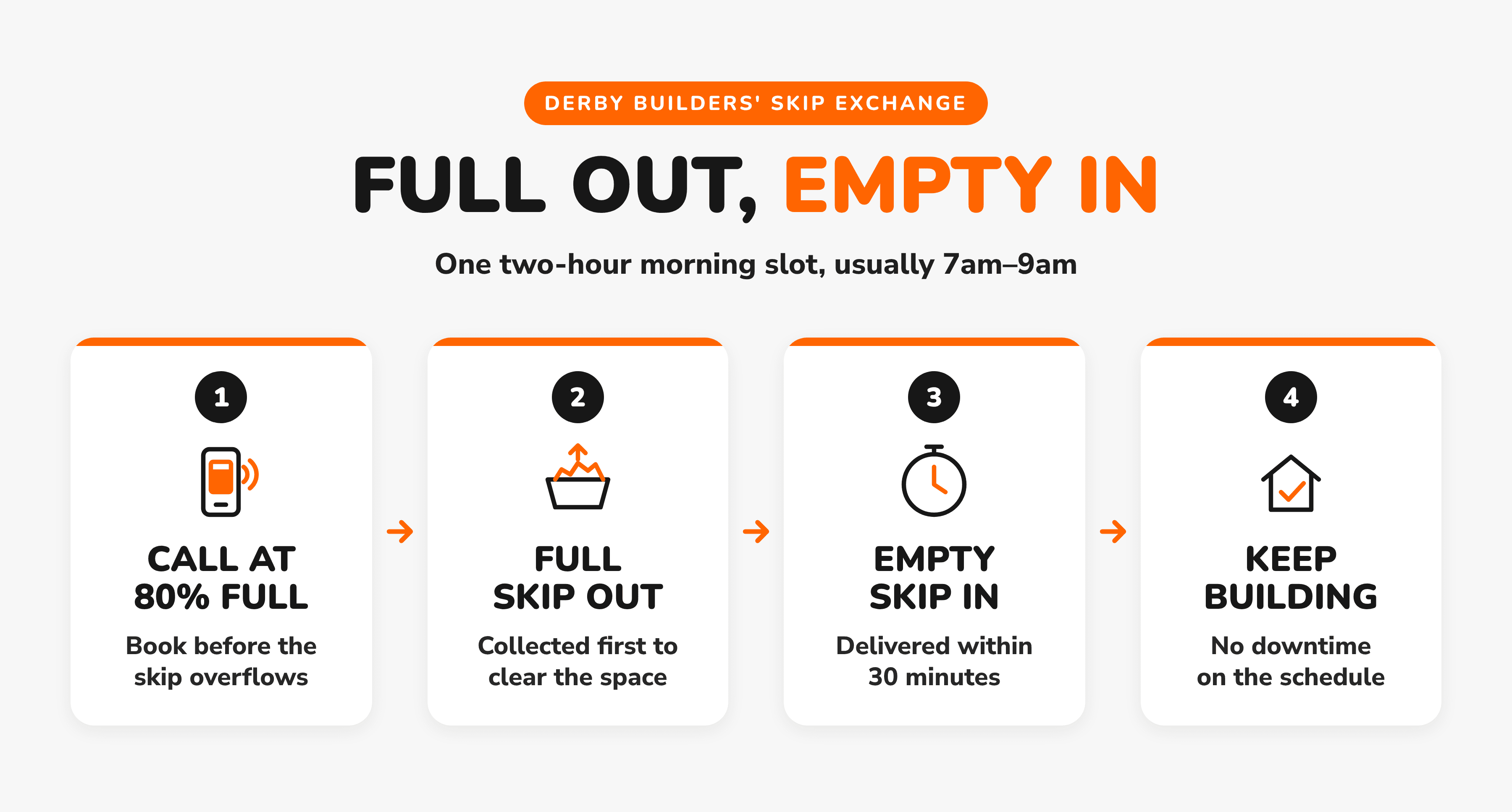
A builder skip exchange isn't complicated in theory, but the timing has to be precise. The builder calls when their current skip hits about 80% capacity. I arrange to collect the full skip and deliver an empty one within the same two-hour window, usually between 7am and 9am when site access is clearest.
The coordination matters more than you'd think:
Full skip collection happens first, creating space immediately
Empty skip delivery follows within 30 minutes maximum
Site work continues with minimal interruption to the building schedule
Material deliveries can happen the same day without access problems
Neighbouring properties see less disruption from extended skip presence
One of my regulars in Spondon runs three separate renovation projects simultaneously. He books exchanges every Thursday and Monday, rotating skips between sites based on which trades are active where. His plasterers know they'll have clear waste capacity on Thursdays. His roofers book in for Mondays when the slate waste skip arrives fresh.
The Economics Behind Quick Turnarounds
I was sceptical about skip exchanges initially because I thought they'd cost builders more. Wrong assumption. A builder doing a full house renovation in Littleover showed me his numbers from a job completed in March 2023.
Traditional approach with longer hire periods:
Three skips hired for 14 days each at £186 per skip
Total skip hire cost: £558
Exchange approach with 3-day turnarounds:
Five skip exchanges over 11 weeks at £142 per exchange
Total cost: £710, but project completed 9 days earlier
Earlier completion freed up labour for next job, earning £1,240 additional revenue Net benefit: £530 despite higher skip costs
Reduced site storage requirements saved £180 in temporary fencing
The numbers convinced me that builders weren't just being efficient with waste management. They were using skip timing as a project management tool.
Site Access Challenges in Derby's Housing Stock
Derby's terraced streets weren't designed for modern building projects. I've delivered skips to Victorian terraces in Sinfin where the front garden measures exactly 11 feet from gate to front door. A 10 yard skip hire needs 14 feet of clear space plus room for safe positioning.
Smart builders solve this by timing exchanges around other site activities. One builder in Oakwood schedules his skip exchange for the same morning his brick delivery arrives. The lorry driver helps position the new skip while loading materials, and both vehicles leave together. No extended disruption, no parking complications.
But I've seen this go wrong too. A job in Chellaston last summer had the builder book an exchange for the same Tuesday his scaffolding crew were due to dismantle. The scaffold van blocked skip access, the exchange got delayed until Thursday, and wet weather meant the exposed brickwork needed covering for two extra days. Sometimes coordination works against you.
Common Mistakes That Cost Time and Money
The biggest mistake I see builders make with exchanges is underestimating fill times. A kitchen and bathroom renovation looks straightforward until you start ripping out tiles, and suddenly you've got 3.2 tonnes of ceramic waste in a skip rated for mixed building materials.
I remember one job in Derby city centre where the builder called for an exchange on Friday afternoon, expecting to fill the replacement skip by Monday. His demolition work took longer than expected, the new skip sat empty over the weekend, and he paid for five days of hire on an unused skip. Learning point there about realistic planning.
Weather timing matters more than builders expect. I've learned not to schedule exchanges during heavy rain periods because accessing skips becomes dangerous, and wet waste weighs significantly more than dry materials. A skip that should handle a bathroom renovation easily can hit weight limits if everything gets soaked during a thunderstorm.
Why Small Builders Struggle With Traditional Skip Hire
Large construction companies can afford to have multiple skips on site simultaneously. Small builders can't, and that creates specific problems that why small builders struggle with skip hire becomes obvious once you see the constraints they work within daily.
A two-person building team doing a house extension in Darley Abbey doesn't have the luxury of dedicated waste sorting areas. Everything gets mixed together throughout the day, and they need waste removal capacity that matches their work rhythm, not a fixed weekly collection schedule.
I've watched small builders lose entire working days because their skip filled up unexpectedly and they couldn't continue until a replacement arrived. That's dead time they can't afford, especially when they're competing against larger firms for the same projects.
Timing Skip Exchanges for Zero Downtime
The most successful builders I work with have learned that timing skip exchanges for zero downtime requires thinking about waste generation patterns, not just calendar dates.
Demolition phases generate waste quickly but unpredictably. A builder removing a kitchen in Breadsall might fill 60% of their skip on Monday morning, then generate almost nothing for two days while waiting for building control approval. Planning exchanges around work phases, not time periods, prevents both overflow and unnecessary empty skip days.
One particularly organised builder I know in Alvaston keeps a waste generation log. He tracks how much material each trade produces per day, and books exchanges based on cumulative waste patterns rather than guesswork. His skip utilisation runs at about 94%, which is remarkably efficient for small-scale building work.
What the Future Looks Like
I've noticed more builders adopting app-based booking systems that let them schedule exchanges with just 24 hours notice. Some skip hire companies around Derby, including options like easyskip.uk, offer same-day exchanges during busy periods, which gives builders more flexibility to respond to project changes.
The trend toward shorter hire periods with more frequent exchanges seems likely to continue. Builders are recognising that waste management timing affects their entire project schedule, not just their disposal costs. I expect to see more coordination between skip hire companies and builders' project management systems over the next few years.
Whether this approach works for every small building project depends largely on the builder's ability to predict and plan their waste generation accurately. The ones who've mastered it are definitely working more efficiently than they were five years ago.
Next time you're planning a building project, track your waste generation for the first week and see if your skip hire schedule actually matches your work pattern.