


16 Yard Skip Hire for Festival and Venue Clear-Ups
Sarah Baker• 16.11.2026

How lightweight bulky waste fills these giants faster than you'd think
I was standing in a muddy field outside Chelmsford on a Tuesday morning in September 2019, watching our crew position eight skips around the perimeter of what had been a food festival the weekend before. The organisers had booked 16 yard skips because they expected mountains of waste, but I could already see we'd made the wrong call.
The problem wasn't volume. Festival waste is deceptive that way. You get plastic chairs with one broken leg, collapsed gazebos that spring back to full size the moment you touch them, and cardboard boxes that compress down to nothing until they're soaked with rain. Then they expand again.
That's when I learned that 16 yard skip hire for events needs a completely different approach than construction clearances. The skip looked enormous next to a pile of folding tables, but by 11am we'd filled it to the brim with what felt like barely anything.
Why Event Waste Fools Everyone
Festival organisers always underestimate how much space their rubbish will take. I've watched this happen dozens of times. They think in terms of weight because that's how they buy their supplies. A hundred plastic chairs weigh maybe 180kg. But stack them in a skip after they've been used, damaged and rained on, and you'll need half the container just for those chairs. The worst offenders are the things that look compact when they arrive:
Promotional banners that tear into long strips
Inflatable decorations that can't be deflated properly
Catering equipment boxes that vendors abandon rather than flatten
I remember one outdoor wedding in a village near Stamford where the hire company had left behind 47 round tables. Stacked properly, they should have fitted in one corner of our 16 yard skip . But the legs wouldn't fold, three were cracked, and someone had tried to nest them wet. They took up two-thirds of the container.
The Physics of Lightweight Bulky Items
Here's what I wish someone had explained to me years ago. Lightweight bulky waste doesn't behave like rubble or timber. It creates its own structure inside the skip, with air gaps you can't eliminate no matter how you pack it.
Take something simple like a damaged gazebo frame. The metal poles might weigh 15kg total, but they'll sprawl across 3 cubic metres of skip space. You can't compress them, you can't nest them efficiently, and if you try to break them down, you'll spend more on labour than the materials are worth.
And festival waste gets worse over time. I've seen perfectly stackable plastic chairs become impossible to nest after a weekend of use. People lean on them, stack them wrong, or leave them out in weather. What arrived as a neat, compact delivery becomes a skip-filling nightmare.
Planning Skip Numbers for Venue Clear-Ups
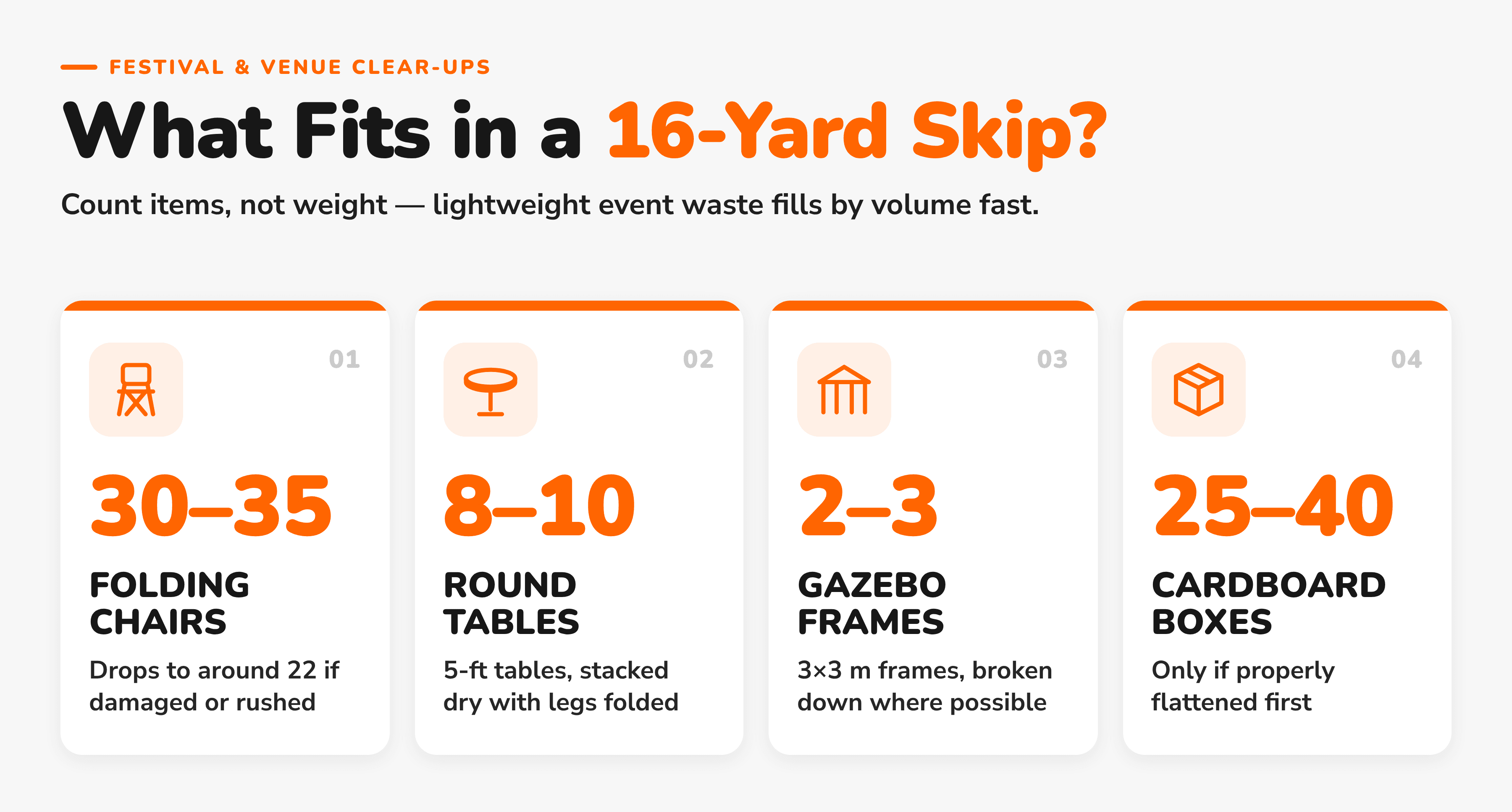
The formula I use now is completely different from construction waste. For an event waste skip job, I count items, not weight. A 16 yard skip will hold roughly 35 standard plastic chairs if they're in good condition and you've got time to stack them properly. But if they're damaged or you're working fast, cut that number to 22.
These are my rough guidelines based on jobs I've actually done:
Folding chairs in good condition: 30-35 per skip
Round tables (5-foot diameter): 8-10 per skip
Gazebo frames (3x3 metre): 2-3 per skip, depending on how they've been dismantled
Catering equipment boxes: 25-40, but only if they're properly flattened
Display boards and signage: impossible to predict, depends entirely on size and whether they fold
The Weight Limit Reality
People book 16-yard skips for events because they think bigger is always better. But there's a reason why 16 yard skips can't take heavy waste , and it affects event planning more than you'd expect.
I learned this the hard way at a craft fair in Taunton. The organisers had ceramic display pieces, metal sculpture stands, and wooden booth frameworks mixed with the usual plastic furniture. The skip was only half full by volume, but we were already at the 10-tonne weight limit. We had to leave behind two piles of perfectly good waste and book a second collection.
Most event waste is genuinely lightweight, but you can't assume everything will be. Wooden staging, metal barriers, or anything involving concrete bases will push you over the limit long before you fill the skip.
Loading Strategies That Actually Work
The key to efficient event clear-ups is loading technique. I've watched volunteer teams throw items randomly into skips and end up needing twice as many containers as they should have. Level loading for safe collection becomes crucial when you're dealing with awkward shapes that want to spring back up.
Start with the largest, flattest items as your base layer. Tabletops work well if you can remove the legs. Then build up with smaller items, using every gap. The mistake most people make is treating the skip like a dumping ground instead of a packing puzzle.
Timing and Weather Considerations
September taught me never to leave festival skips on-site overnight if rain is forecast. We had a skip at an outdoor market in Kidderminster that was maybe 60% full on Friday evening. Light shower overnight. By Monday morning, every piece of cardboard had expanded, fabric items had doubled in weight, and what should have been an easy collection became two skip loads.
Weather affects more than just capacity. Wet items stick together, creating lumps that won't settle properly. Plastic becomes slippery and harder to stack. Metal chairs develop a coating of mud that adds weight and makes them impossible to nest cleanly.
The timing of your skip delivery matters too. Arrive too early and the skip becomes a dumping ground for setup waste that could have been managed separately. Arrive too late and you're working in the dark, trying to load awkward items by torchlight.
What Really Drives Up Costs
The biggest cost surprise in event clear-ups isn't the skip hire itself. It's the labour time. Lightweight bulky waste is deceptively time-consuming to load properly. Each item needs individual handling, and there's no mechanical loading like you'd use for soil or rubble.
I've timed crews loading different types of waste. Construction rubble: maybe 15 minutes to fill a skip with a mini-digger. Event waste with damaged furniture and display materials: 2-3 hours with a three-person team working steadily. The skip costs the same, but the labour bill triples.
Multiple collections add another layer of expense. If you underestimate and need a second skip, you're paying delivery charges twice, plus the disruption to your clear-up schedule. I've seen event organisers save £200 on skip hire and then spend £800 on overtime because they couldn't clear the site in one day.
Alternative Approaches Worth Considering
Sometimes 16 yard skip hire isn't the right solution at all. For events with lots of salvageable furniture, I've seen organisers have more success with multiple 8-yard skips positioned around different waste streams. Damaged goods in one skip, recyclable materials in another, genuine rubbish in a third. Services like easyskip.uk often have flexible arrangements for event clear-ups, including same-day swaps if you fill containers faster than expected. That flexibility is worth paying for when you're working to tight venue deadlines. The approach that's worked best for me is booking one fewer skip than I think I need, with a backup collection arranged for the following day if required. Better to have a slightly overpacked skip than empty capacity you've paid for but can't use. Next time you're planning an event clear-up, walk the site beforehand and count the actual items, not their weight or original volume. Your skip budget will thank you for it.