

Skip Hire Guide
What Size Skip Do I Need for a House Extension or Building Work?
Last updated: June 2026
A house extension or significant building work generates more waste than almost any other domestic project — foundation excavation soil, old brickwork, timber, plasterboard, cement bags, packaging and mixed rubble all need managing. The right skip size depends critically on whether your waste is predominantly heavy (soil, rubble) or light (timber, plasterboard). For most single-storey extensions, a 6 yard skip for heavy waste and an 8 yard skip for mixed light waste is the standard approach.
Recommended
8
Yard Skip
70-90 bin bags
Quick Answer
For heavy waste (soil, rubble, foundations) from a house extension, use a 6 yard skip — it is the maximum safe size for dense materials. For mixed or light construction waste (timber, plasterboard, packaging), an 8 yard skip is ideal. Large extensions typically need both.
easySkip arranges house extension & building work hire in London, Manchester, Birmingham, Leeds, Glasgow and 1,000+ UK postcodes — same licensed service, same documentation.
What Types of Waste Does a House Extension or Building Work Generate?
A house extension or building project generates a heavy and varied mix of construction waste. Knowing what you'll be disposing of from the start helps you choose the right skip size and avoid costly overloads or swap-outs mid-build.
Excavation Soil & Hardcore
Foundation digging and groundwork generates significant volumes of soil, clay, gravel and hardcore. These are among the heaviest materials on any building site and must be declared at booking as they may require a dedicated heavy waste skip.
Concrete & Masonry
Broken concrete from foundations, old brickwork, blocks and mortar rubble make up a large portion of extension waste. Place these at the bottom of the skip and declare large volumes at booking due to weight limits.
Timber & Structural Waste
Offcuts from floor joists, roof timbers, studwork and general carpentry waste are common throughout a house extension build. Break down large sections before loading to maximise skip space.
Plasterboard & Insulation
Internal partitioning, drylining and insulation work generates significant plasterboard waste. Small quantities can go in a standard skip but large volumes must be declared at booking under UK landfill regulations.
Roofing Materials
Felt, battens, tiles and membrane offcuts from the extension roof can go in a standard skip as part of the general mixed load.
Packaging Waste
Windows, doors, insulation, sanitaryware and structural materials all arrive with substantial packaging — cardboard, polystyrene and plastic wrapping. This is consistently underestimated on building projects.
Recommended Skip Size for a House Extension or Building Work
Choose the right skip size for your project scope. All sizes listed are for light commercial waste only — NOT suitable for heavy materials such as concrete or soil.
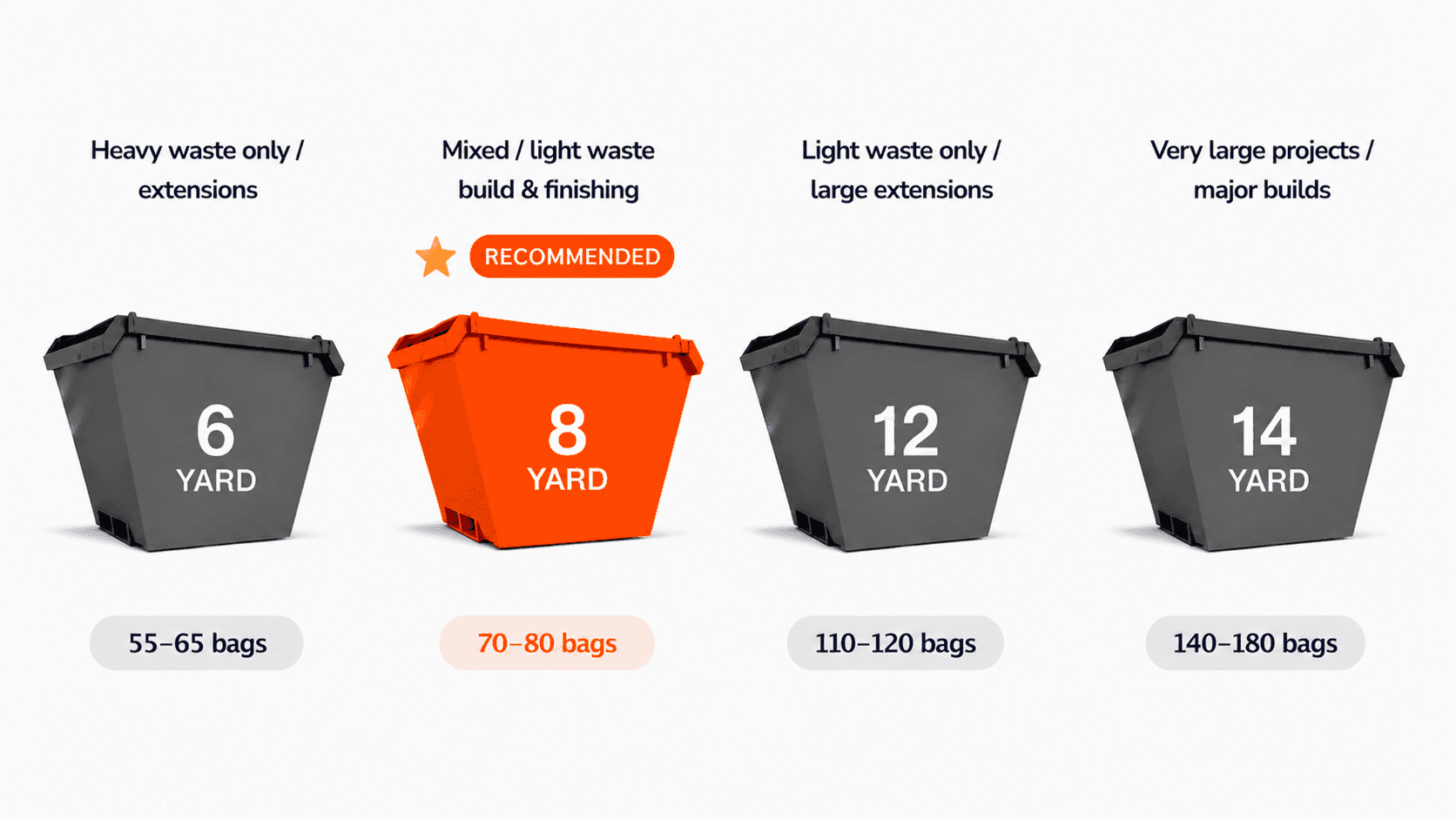
6Yard Skip
**Best for partial clearances — clearing one or two rooms, a loft, or a garage. **
Holds ~55–65 bin bags.
8Yard Skip
**The most popular choice for standard 2–3 bed house clearances. Large enough for furniture, bulky items and general household contents. **
Holds ~70–80 bin bags.
Recommended
Book 8 Yard →12Yard Skip
**Best for larger properties (4+ bedrooms) or full estate clearances where significant furniture, white goods and general household contents need to go. **
Holds ~110–120 bin bags.
14Yard Skip
**For very large properties or commercial clearances. Often used where extensive renovation waste is also present. **
Holds ~140–180 bin bags.
Key Considerations for House Extension Skip Hire
Before your skip is delivered, a few practical considerations will help the hire go smoothly and keep your build programme on track.
Access and Positioning
Building site skips need to be positioned close to the work area without obstructing contractor access. Make sure there is clear vehicle access for delivery, as easySkip's trucks require a minimum width of around 3 metres. Coordinate skip placement with your contractor before delivery day.
Permits and Road Placement
If the skip cannot fit on private property, it can go on the public road with a council skip permit. For larger 12 to 16 yard skips, confirm road placement suitability with your local council and easySkip before booking. Please note: permit fees are non-refundable if your booking is cancelled.
Weight Limits — Soil, Concrete and Rubble
Excavation soil, concrete and hardcore are significantly heavier than general construction waste. Large volumes of these materials must be declared at booking as they may exceed standard skip weight limits and require a dedicated heavy waste skip. Overweight skips cannot be safely collected and carry a minimum surcharge of £50 + VAT.
Plasterboard Segregation
Plasterboard must be kept separate from general construction waste under UK landfill regulations and is listed as a prohibited item under easySkip's terms and conditions. Declare plasterboard at booking so the correct waste type can be arranged. Undeclared plasterboard incurs a minimum surcharge of £100 + VAT.
Neighbour Consideration
House extensions already generate noise and disruption for neighbours. If the skip will also partially block a shared access or narrow road, let your neighbours know in advance. For road-placed skips, easySkip will fit the required safety lights and cones as standard.
Waste Transfer Documentation
For building projects involving contractors, ensure your builder is using a licensed waste carrier and that a Waste Transfer Note is issued for every skip collected. Replacement Waste Transfer Notes are available at £15 + VAT. Under the Environmental Protection Act 1990, the householder shares Duty of Care responsibility for waste generated on their property.
How Long Can I Keep the Skip?
easySkip's house extension skip hire is designed to flex around your build programme, whether you need a skip for the groundworks phase only or throughout the full construction.

Standard Hire Period
Your hire period will be confirmed in your booking confirmation email, giving your contractor enough time to work through each phase of the build without feeling rushed. Most single-storey extension groundworks and structural phases are completed well within the standard hire window.

Extended Hire & Swap-Outs
Building projects frequently overrun due to weather delays, material lead times or unexpected groundwork issues. Contact easySkip to extend your hire — extensions are subject to availability and charged from £15 + VAT per day. A swap-out skip can also be arranged once the first is full. Multiple skip bookings across the build programme are common on larger extensions.

Flexible Collection
Once your skip is full and you are ready, book your collection online or by phone. There is no need to wait for the end of your hire period, so you can collect early and keep the site clear for the next phase of work.

Fit-to Build Planning
Coordinate skip deliveries with your contractor's programme. Book a skip for groundworks, then a fresh skip for the structural and first-fix phase, and a final skip for second-fix and finishing waste. This keeps the site tidy and avoids one overloaded skip at the end of the project.
Restricted Waste Streams in House Extensions & Building Work
A standard house extension skip accepts most general construction waste, but certain materials are restricted by UK law and cannot be mixed with your regular skip load. Declare them at booking to avoid surcharges or rejected loads.

Asbetos
Properties being extended or altered that were built before 2000 may contain asbestos in roof materials, floor tiles, pipe lagging or textured coatings. If your contractor suspects asbestos during the build, work must stop immediately. Arrange a licensed asbestos survey and specialist removal before the skip is delivered to that area.

Excavation Soil & Hardcore
Large volumes of excavation soil, concrete and hardcore must be declared at booking as these materials are significantly heavier than general construction waste and require a dedicated heavy waste skip. Mixing large amounts of soil with general waste can cause the skip to exceed safe weight limits.

Plasterboard
Plasterboard must be declared at booking as it requires separate disposal under UK landfill regulations and is listed as a prohibited item under easySkip's terms and conditions. Undeclared plasterboard incurs a minimum surcharge of £100 + VAT. easySkip will advise on the correct waste type at booking.

Electrical Items (WEEE)
Any electrical fittings, wiring, storage heaters or appliances removed during the building work cannot go in a standard skip. These must be recycled separately via your local council or a licensed WEEE facility.

Hazardous Construction Materials
Old lead paint, bitumen-based products, contaminated soil and chemical treatments cannot be placed in a standard skip. Dispose of these via a licensed hazardous waste contractor.

Fluorescent Light Tubes & Batteries
These contain hazardous materials and must not go in a standard skip. Return batteries to any retailer collection point and fluorescent tubes to a specialist recycling facility.
What Can & Can't Go in Your House Extension Skip
Important — Pre-Notification Required for Some Waste Types
Large quantities of excavation soil and hardcore, plasterboard, electrical items (WEEE), and any materials suspected to contain asbestos are not accepted in a standard house extension skip without prior declaration. If your project generates these materials, you must tell easySkip at the point of booking so the waste type can be amended and the correct disposal route arranged. Under our terms and conditions, loading undeclared restricted items into a standard skip incurs a minimum surcharge of £100 + VAT (and from £250 + VAT for hazardous waste), and the load may be rejected on collection.
✓ Can Put In
- Bricks and masonry (weight limits apply)
- Concrete offcuts and old foundations (weight limits apply)
- Timber framework and offcuts
- Old roof tiles and slates
- Soil and excavated clay (6 yard max)
- Hardcore and aggregate
- Old windows and door frames (non-hazardous)
- Cement bags and packaging
- Insulation materials
- Mixed general construction waste
✕ Can't Put In
- Asbestos — especially in pre-1980 properties being extended through
- Gas pipes, meters or cylinders
- Electrical items (WEEE)
- Hazardous chemicals — solvents, paints, treatment chemicals
- Contaminated soil (if on brownfield land)
- Tyres
- Batteries
- Clinical or medical waste
- Liquids including paint, oil or chemical waste
- Plasterboard — must be declared separately at booking