


12 Yard Skip Hire London: Getting a Big Skip Into Mews Streets
• 02.11.2026

How I learned to navigate permits, residents and tight spaces in London's most awkward corners
I'd been managing small building jobs around Hammersmith for six years when a client called me about her Victorian terrace conversion in November 2019. The house sat tucked behind a narrow mews off King Street, and she needed the full works done. New kitchen, two bathrooms, complete rewire. The usual story, except this job would generate enough waste to fill three builder's bags every day for eight weeks straight.
Standing in that cramped mews on a Tuesday morning, measuring the space between her front door and the nearest lamp post, I realised my usual approach wouldn't work. The street was barely wide enough for two cars to pass each other. A standard 6-yard skip would block everything. But trying to manage that volume of waste with bag collections would cost her nearly double, and the delays would push the job well into December.
That's when I started looking seriously at 12 yard skip hire London options that could handle the volume while still fitting the space constraints. What I learned over the next few months changed how I approach every central London job.
Why London Mews Streets Break the Standard Rules
Most skip hire London guidance assumes you're working with normal suburban streets. Wide pavements, predictable parking, councils that process permits within five working days. London's mews streets operate by different physics entirely.
Take the street where I was working. Built in 1887 for horse-drawn carriages, it measured just 4.2 metres from wall to wall. The residents had fought for years to keep delivery trucks out during morning hours. Three of the houses had been converted to flats, which meant six different sets of opinions about skip placement. And Hammersmith & Fulham Council required a separate permit for each seven-day period, with no option to extend.
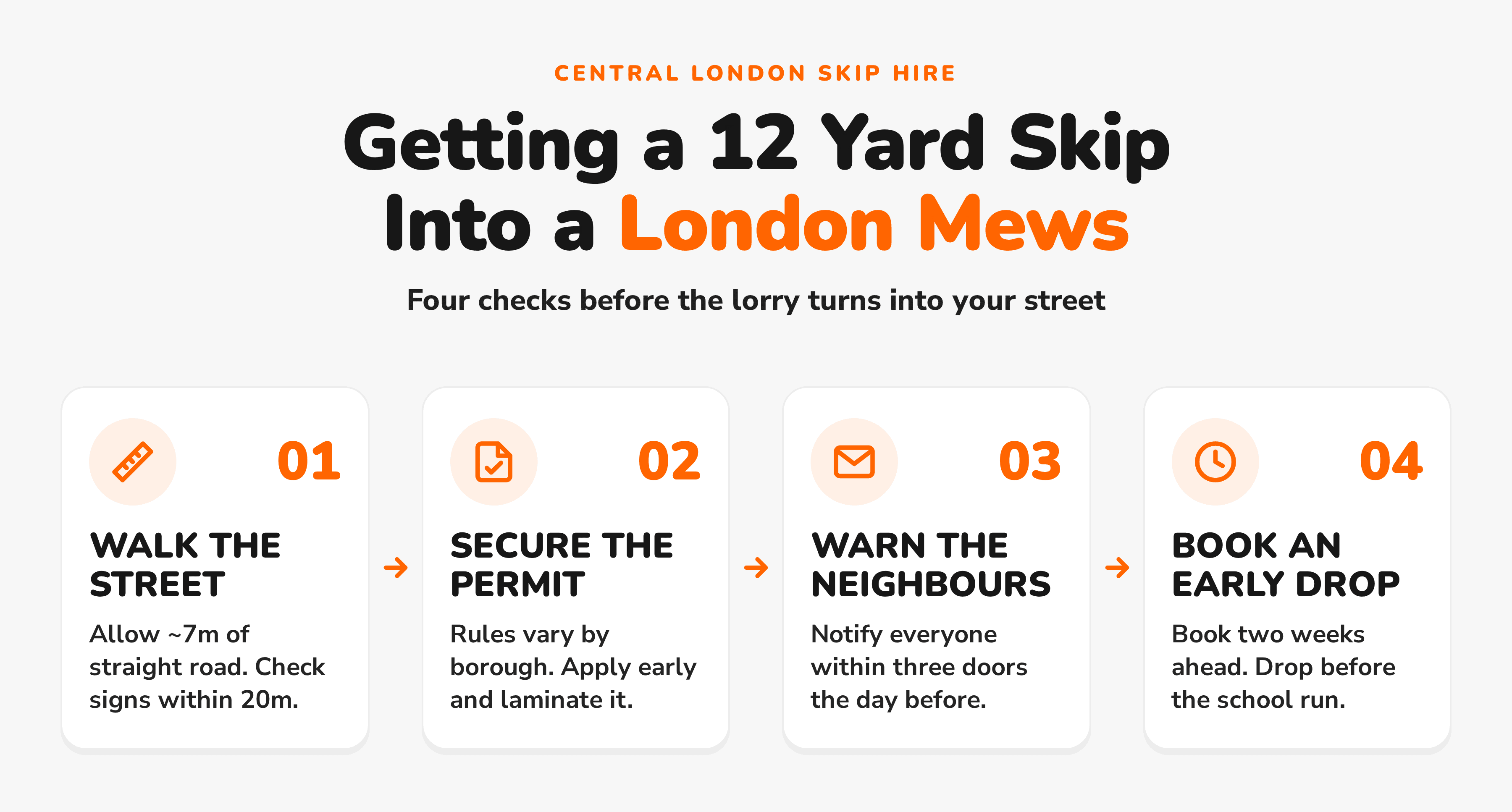
The geometry problem hit me first. A 12 yard skip hire London truck needs roughly 7 metres of straight road to position the skip safely. But in a 4.2-metre-wide mews, that means blocking both directions of traffic completely during the drop-off. Residents start their cars at 7:30am for the school run. Miss that window, and you're negotiating with people who are already twenty minutes late for work.
I made that mistake exactly once. The skip lorry arrived at 8:15am on a Wednesday morning in March 2020, just as lockdown was starting. Mrs Patterson from number 14 had been stuck behind the truck for eleven minutes, engine running, trying to get to Charing Cross Hospital for a cancelled appointment she didn't yet know about. She wasn't interested in hearing about permit procedures.
The London Skip Permit Maze
Every London borough handles London skip permit applications differently, and the differences matter more than you'd think. Hammersmith & Fulham charges £37 per week and requires five clear working days' notice. Kensington & Chelsea next door charges £65 per week but processes applications in three days. Westminster charges £89 per week and demands detailed drawings showing exactly where the skip will sit.
The permit arrives as a printed sheet you tape to the skip, but London weather destroys paper faster than anywhere else I've worked. Rain, wind, and the exhaust fumes from buses combine to turn permits into illegible pulp within 48 hours. I started laminating every permit after getting a £120 penalty notice for a skip with a perfectly valid but unreadable permit stuck to its side.
Camden introduced digital permits in 2021, which solved the weather problem but created new ones. The QR code system works fine until enforcement officers try to scan codes in direct sunlight or when mobile signal drops to nothing, which happens regularly in the narrow streets around Bloomsbury. I watched one officer spend fifteen minutes trying to verify a skip permit outside the British Museum while the skip sat legally on a valid permit that just wouldn't scan.
Controlled Parking Zones and Skip Politics
The real complexity starts when your controlled parking zone skip needs to sit where residents normally park. Most London streets have some form of controlled parking, and residents defend their spaces with the intensity of people who've waited three years for a parking permit.
I learned this lesson the expensive way in South Kensington during summer 2021. The job was a basement conversion in a garden square where parking spaces changed hands for £85,000. Yes, that's the price of buying a parking space, not a year's rent. Dropping a 12-yard skip into that equation requires diplomatic skills they don't teach on building courses.
The solution involved negotiating with three separate residents who owned spaces near the building. Mrs Chen agreed to move her Volvo for two days in exchange for having her kitchen tiles delivered at the same time as our materials delivery. Mr Abdullah wanted compensation for losing his space but settled for us pressure-washing his parking bay when we finished. The third resident simply refused to engage, so we hired a smaller skip and accepted the higher cost per cubic metre.
Check every parking restriction sign within 20 metres of your planned skip position
Photograph the exact spot where the skip will sit, including all visible signage and bay markings
These details matter because parking enforcement in central London operates on commission. Wardens earn bonuses for penalty notices issued, which creates an incentive to find problems with skip placement even when permits are valid.
Garden Squares and Listed Building Constraints
Garden squares bring their own complications that most contractors never consider. Many squares have restrictive covenants dating back to Victorian times that limit commercial vehicle access. The management companies that run these squares often require separate permissions beyond the council permit, and they're not always cooperative about building work.
I discovered this working in Bedford Square in early 2022. The garden square management company charged £150 per week for skip permission on top of Camden Council's £78 permit fee. They also insisted on daily inspections to ensure the skip wasn't damaging the Victorian paving stones, which meant someone had to be on site every morning at 9am to meet their representative.
The inspection process revealed problems with standard skip design that I hadn't anticipated. The metal feet on most 12-yard skips concentrate enormous weight onto small contact points, which can crack heritage paving or damage underground services. The solution involved hiring skips with rubber feet and steel plates to distribute the load, which cost an extra £45 per skip but prevented a £2,800 repair bill for damaged stonework.
Listed building constraints add another layer of complexity. English Heritage guidelines restrict vehicle access to listed buildings, even when the buildings aren't officially protected. I spent three weeks getting permission to place a skip outside a Grade II listed townhouse in Marylebone, only to discover that the building's insurance required all contractors to use biodegradable bags instead of metal skips.
The Reality of London Skip Logistics
Central London skip delivery operates on military precision because there's no room for error. Traffic wardens start work at 8am sharp. Loading bays fill up by 8:30am. Miss your delivery slot, and you're rescheduling for tomorrow or paying premium rates for evening delivery.
The skip hire companies that work consistently in London have adapted their operations around these constraints. They schedule deliveries in 30-minute windows and charge extra for delays caused by traffic or parking problems. One company I use regularly keeps spare permits for every London borough and can switch locations within 48 hours if residents complain or parking restrictions change.
But the system breaks down when multiple factors align badly, as I learned during the construction boom of late 2021. Skip demand peaked just as several London boroughs tightened permit requirements and reduced the number of highway licenses they issued per month. The combination created waiting lists for 12 yard skip hire London services that stretched beyond three weeks.
Book skip delivery at least two weeks before you need it, particularly during spring and summer
Have backup plans for waste removal in case skip delivery gets delayed
Keep contact details for multiple skip hire companies, as availability changes weekly
During that period, I started using easyskip.uk for jobs in West London because they maintained reliable delivery schedules even when other companies were overbooked. Their online permit application system also reduced the administrative overhead that was eating into job budgets.
Traffic Management and Resident Relations
Successful skip placement in London depends heavily on managing relationships with people who live and work nearby. This isn't just courtesy, it's practical necessity. Angry residents call councils to complain about permits, they block access routes with their cars, and they report minor infractions that can result in penalty notices.
I started leaving notes through doors the day before skip deliveries after a particularly difficult experience in Notting Hill. The job involved renovating a flat above a restaurant, and neither the restaurant staff nor the upstairs neighbours knew about our plans. When the skip lorry arrived at 7:30am on a Thursday, it blocked the restaurant's loading bay during their morning delivery window. The restaurant manager threatened to call the police, the neighbours complained about noise, and I ended up paying £200 to have the skip moved to a different street.
Now I always notify everyone within three doors of the skip location. The note explains when the skip will arrive, how long it will stay, and includes my mobile number for any problems. This approach has prevented dozens of disputes and actually generated several new jobs from neighbours who saw the quality of our work.
The relationship management extends to parking wardens and council enforcement officers. Building positive relationships with the people who patrol your area regularly can prevent problems before they escalate. I make a point of introducing myself to wardens when I see them, explaining what we're doing and showing them our permits. Most enforcement officers appreciate contractors who follow the rules properly, and they're often helpful about avoiding common permit problems.
Alternative Solutions When Standard Skips Don't Work
Some London locations simply cannot accommodate a 12-yard skip, regardless of permits or resident cooperation. Streets that narrow to less than 3.5 metres, areas with constant delivery traffic, or buildings with basement access that requires keeping the pavement clear all create situations where standard skip hire becomes impossible.
The most common alternative involves using smaller skips with more frequent collections, but this approach costs significantly more per cubic metre of waste removed. A job that would fill one 12-yard skip requires two 6-yard skips or three 4-yard skips, which means multiple permit fees and delivery charges. I calculated the cost difference on a recent job in Fitzrovia at roughly 40% more expensive for the same volume of waste removal.
Grab lorries offer another solution for jobs with good vehicle access but no space for skip storage. The lorry arrives, loads waste directly from the building, and leaves immediately. This works well for single-day clearances but becomes impractical for ongoing building work that generates waste continuously over several weeks. The logistics of coordinating grab lorry visits with building work schedules often create more delays than they solve.
Some contractors use micro-access skip solutions for terraced homes that can navigate extremely tight spaces, though these typically max out at 8 cubic yards and require specialized delivery vehicles that cost more to hire.
Builder's bag collections work for materials like plasterboard and timber that pack efficiently
Same-day grab lorry hire suits bathroom renovations where waste volumes are predictable
Mini skips with daily collections can work for jobs with consistent waste generation
Segregated waste streams sometimes allow direct delivery to recycling centers, bypassing skip hire entirely
Negotiating shared skip access with neighbouring building projects reduces costs for both jobs
Cost Realities and Budget Planning
London skip hire costs reflect the complexity of operating in dense urban areas with strict regulations. A 12-yard skip that costs £280 in Surrey will typically cost £420 in central London once you include permit fees, delivery surcharges, and the risk of penalty notices or failed deliveries.
The permit fees alone add substantial cost to every hire. Westminster charges £89 per week, but jobs rarely fit into neat weekly blocks. A renovation that takes nine days requires two permit periods, effectively doubling the permit cost. Some councils offer discounts for multiple consecutive permits, but others treat each week as a separate transaction.
Penalty notices represent an often-overlooked budget risk. Fixed penalties start at £120 for improper skip placement and can reach £300 for blocking cycle lanes or disabled parking bays. I budget an extra 15% contingency for penalty risks on central London jobs, based on experience of how often minor permit infractions result in fines even when the skip hire company claims to handle all permit compliance.
The hidden costs add up quickly. Failed delivery attempts cost £85 each. Evening or weekend deliveries carry 40% surcharges. Permit modifications or extensions often require full reapplication processes with additional fees. A job I managed in Bloomsbury last year accumulated £340 in additional charges beyond the basic skip hire cost, primarily due to permit complications and one failed delivery caused by residents parking across the planned skip location.
But the cost of not using appropriate skip sizes can be even higher. How tight permit rules delay renovations becomes obvious when you're trying to manage major building work with inadequate waste removal capacity. The delays cascade through the entire project timeline, affecting trades scheduling, material deliveries, and client satisfaction.
Making London Skip Hire Work
Success with large skip hire in central London requires accepting that standard approaches don't apply. The combination of narrow streets, complex permit requirements, and assertive residents creates an environment where preparation and relationship management matter more than cost optimization.
I now start every London job by walking the street at different times of day to understand traffic patterns, parking usage, and potential access problems. Morning school runs, evening commuter parking, weekend visitor traffic, and delivery schedules all affect skip placement options. The fifteen minutes spent observing these patterns typically prevents hours of problems later.
The permit application process works best when you over-communicate with councils rather than trying to minimise contact. Providing detailed site photos, exact measurements, and clear delivery schedules reduces the back-and-forth that delays permit approvals. Most London councils prefer contractors who demonstrate thorough planning over those who submit minimal applications and hope for the best.
Working in controlled parking zone skip areas requires treating residents as partners rather than obstacles. The people who live on these streets deal with building work constantly, and they can distinguish between contractors who respect the neighbourhood and those who don't. Building positive relationships often leads to residents actively helping with access problems, parking coordination, and permit compliance.
The investment in doing London skip hire properly pays back through smoother project delivery, fewer delays, and better client relationships. But it requires accepting that central London operates by different rules, and those rules aren't optional for anyone who wants to work there successfully.
Next time you're planning a major renovation in central London, spend a morning walking the streets around your job site during rush hour. Count the parking spaces, note the permit restrictions, and watch how delivery vehicles navigate the area. The patterns you observe will tell you more about skip hire feasibility than any amount of online research.