


16 Yard Skip Hire Birmingham: When Digbeth's Old Buildings Meet Modern Strip-Outs
Sarah Baker• 05.11.2026

How regeneration projects in Birmingham's creative quarter are changing the way we handle bulky commercial waste
I was standing in a narrow lane off Custard Factory Way on a Tuesday morning in March 2024, watching our driver try to position a massive skip between a Victorian railway arch and a cluster of shipping containers that someone had turned into artist studios. The irony wasn't lost on me. Here I was, a facilities manager for a creative hub in Digbeth, dealing with the messiest part of Birmingham's most exciting transformation.
The 16-yard skip looked enormous against the red brick backdrop, but I knew we'd fill it by Thursday. We were gutting the upper floors of a Grade II listed building that had housed everything from a brass foundry to a nightclub over the past century and a half. Each layer of history came with its own type of waste.
That particular job taught me why 16 yard skip hire Birmingham has become such a common phrase in our corner of the city. When you're dealing with Digbeth regeneration waste, nothing smaller will do. The sheer volume of material that comes out of these old buildings defies belief until you see it piling up in front of you.
The Reality of Strip-Out Waste in Historic Buildings
I've supervised clearances in twelve different buildings around Digbeth and Eastside since 2019, and the pattern is always the same. What looks like a straightforward office conversion on the architect's drawings turns into an archaeological dig through decades of bodged repairs and questionable improvements.
That morning in Custard Factory Way, we pulled out:
Seventeen sheets of asbestos ceiling tiles from a 1970s office fit-out
A tangle of obsolete electrical cables thick enough to trip a horse, most of it copper that the scrap dealer collected separately
Partition walls made from materials I couldn't identify, held together with what appeared to be wallpaper paste and optimism
And that was just the first room. By 11:30am, I was on the phone arranging a second skip.
The building work around here moves fast when it gets going. Developers know that every month of delay costs money, so when they commit to a strip-out, they want it finished yesterday. That puts pressure on everyone, from the demolition crews to whoever's coordinating the waste removal. I learned early that ordering one large skip is usually cheaper than ordering two smaller ones a week apart, especially when you factor in the hassle of permit applications and street management.
Why 16-Yard Skips Dominate Commercial Projects
Size matters when you're clearing commercial buildings.
I remember a conversation with our waste contractor after we'd filled our third consecutive 16 yard skip hire on a conversion project near Birmingham Coach Station. He explained that smaller skips work fine for residential jobs or small retail fit-outs, but commercial strip-outs generate waste in a different league entirely. You're not just removing a kitchen or clearing a garden. You're taking apart entire floors of a building that might have been modified six times since it was built.
The mathematics are straightforward enough. A 16-yard skip holds roughly 12 tonnes of mixed waste, depending on what you're loading. That sounds like a lot until you start pulling down suspended ceilings, removing raised floors, and discovering that someone lined the walls with concrete blocks in 1987 for reasons that died with the planning application.
I've seen contractors try to manage these jobs with 8-yard skips because they're easier to position on narrow streets. It never works. They end up with skips scattered across three different roads, permit costs that spiral out of control, and a project timeline that stretches like elastic. The guidance on 16 yard skip - making every cubic metre count becomes crucial when you're working to tight deadlines and tighter budgets.
Digbeth's Unique Waste Profile
Working in this part of Birmingham teaches you that not all waste streams are created equal. Digbeth sits on top of 200 years of industrial history, and every renovation project becomes a lesson in what previous generations thought was acceptable building practice.
The Victorian buildings around here were built when regulations were lighter and materials were whatever came to hand. I've found horse hair in plaster, newspapers from the 1920s used as insulation, and enough lead paint to worry the environmental health officer. The buildings that survived the Blitz often did so because someone reinforced them with whatever materials were available during rationing.
Modern strip-outs have to deal with all of this plus the accumulated modifications of the past fifty years. Office blocks added in the 1960s came with asbestos as standard. Nightclub conversions from the 1990s involved enough acoustic foam to soundproof a recording studio. And don't get me started on the cables. Every decade brought new communication systems, and nobody ever bothered removing the old ones.
The result is a waste stream that's part building materials, part industrial archaeology, and part environmental hazard. Sorting it properly takes time and expertise, but it has to be done. The regulations around hazardous waste disposal have tightened considerably since I started this job, and the penalties for getting it wrong are serious enough to concentrate the mind.
Street Permits and Positioning Challenges
Getting a 16-yard skip legally positioned on a Birmingham street requires more paperwork than you might expect.
I spent a frustrating Thursday in September 2023 dealing with Birmingham City Council's highways department after we'd placed a skip on Floodgate Street without the proper permit. The enforcement officer was polite but firm. The skip had to move by 5pm or we'd face a £150 fine, and there was no appeals process that would help us in the short term.
The permit system makes sense when you think about it from the council's perspective. Digbeth's streets were designed for horse-drawn carts, not modern construction traffic. Drop a 16-yard skip in the wrong place and you can block emergency vehicle access or create a traffic bottleneck that affects the entire area.
Birmingham's permit fees vary depending on location and duration, but expect to pay around £75 for a week-long placement in most parts of Digbeth. The application process takes at least five working days, so you can't decide on Friday that you need a skip on Monday. I keep a running calendar of permit applications because missing the deadline means either delaying the project or finding expensive private land to store the skip.
Separating Materials for Recycling and Disposal
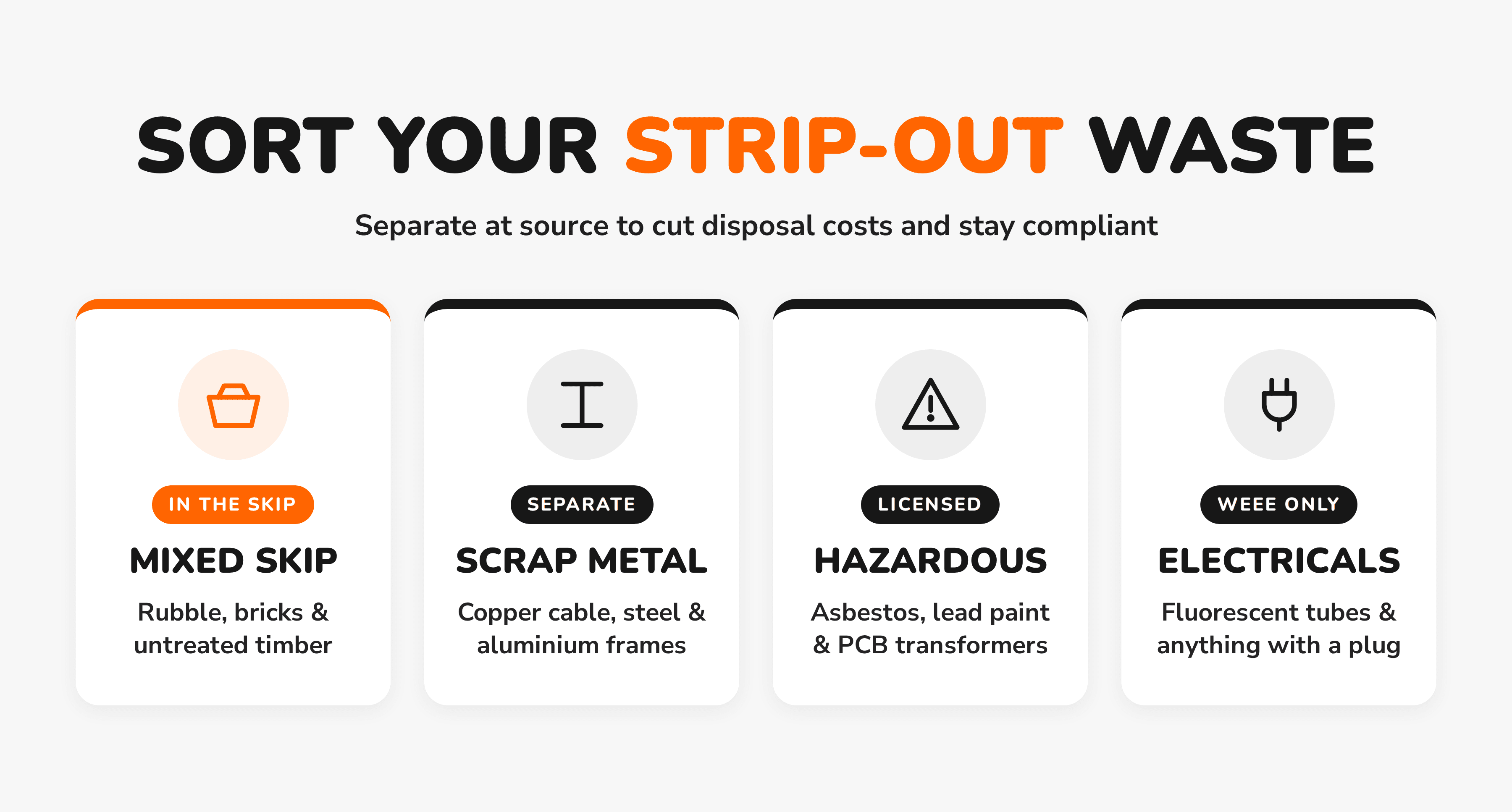
The waste that comes out of commercial strip-outs isn't homogeneous, and treating it as such costs money and breaks regulations.
Metal separation happens on site because the value justifies the effort. Copper cables, steel beams, and aluminium window frames all have scrap value, and most waste contractors will collect them separately if you've done the sorting work. I've seen projects where the scrap metal recovery covered the entire cost of waste disposal, though that depends on commodity prices and how much metal you're dealing with.
Hazardous materials require specialist disposal routes:
Asbestos cement sheets need licensed disposal and can't go in a general waste skip
Fluorescent light fittings contain mercury and fall under WEEE regulations
Lead paint residue from surface preparation counts as hazardous waste
Old electrical transformers may contain PCBs and need specialist handling
Treated timber from industrial applications often can't go to standard recycling facilities
The sorting process slows down the work initially, but it prevents expensive problems later. I learned this the hard way in 2022 when we had to pay extra disposal fees because asbestos fragments had contaminated an entire skip load of otherwise recyclable materials.
Timing and Logistics in Urban Regeneration
Regeneration projects operate on tight schedules, and waste removal sits on the critical path whether anyone acknowledges it or not.
I coordinated a strip-out near Birmingham's Eastside last summer where the developer had scheduled the waste removal for the final week of work. It seemed logical on paper. Complete all the demolition, then clear everything in one efficient operation. In practice, it created a bottleneck that delayed the entire project by three weeks.
The problem was volume. Six weeks of demolition work had filled every available corner of the building with debris. When the commercial skip Birmingham contractor arrived to start clearing, they couldn't access half the material because it was buried under other waste or blocked by structural debris that should have been removed earlier.
I now schedule waste removal as an ongoing process rather than a final cleanup. One skip arrives when we start the ceiling removal, another appears when we begin the partition walls, and a third handles the floor materials and final clearance. It costs more in permit fees and coordination time, but it keeps the project moving and prevents the building from becoming a temporary landfill site.
The decision between different skip sizes often comes down to site access rather than waste volume. The comparison in 16 yard vs 14 yard skip decision matters less than whether your chosen skip will actually fit through the site entrance and leave enough room for other construction traffic.
Environmental Compliance and Record Keeping
The paperwork side of commercial waste disposal has grown more complex since the Environment Act 2021 came into force.
Every skip load needs proper documentation, from the waste transfer note that travels with the skip to the final disposal certificate that proves the materials reached an authorized facility. I keep digital copies of everything because environmental audits can happen months after a project finishes, and missing paperwork creates problems that are expensive to resolve.
The duty of care requirements mean I need to verify that any waste contractor we use holds the proper licenses and insurance. I've seen facilities managers get caught out by using unlicensed operators who offer attractive prices but can't provide proper disposal documentation. The savings disappear quickly when the Environment Agency starts asking questions about where the waste actually went.
Electronic waste streams require particular attention in commercial buildings. Old computer equipment, servers, and telecommunications hardware fall under WEEE regulations, which means they can't go in a general waste skip regardless of size. I arrange separate collection for anything with a plug or a circuit board, partly because it's legally required and partly because some of the components have recovery value.
Cost Management and Budget Planning
Waste disposal costs on regeneration projects can surprise developers who haven't worked in Birmingham's historic buildings before.
A typical 16 yard skip hire in central Birmingham costs around £380 for a week's hire, including delivery, collection, and disposal to a licensed facility. That sounds straightforward until you factor in the hidden costs. Permit fees add £75. Hazardous waste disposal for a single asbestos ceiling can add £200. Heavy materials like concrete or rubble might trigger weight surcharges that increase the bill by 30%.
I budget £150 per tonne for mixed commercial waste disposal, though the actual cost varies depending on the waste composition and current landfill tax rates. Materials that can be recycled cost less to dispose of, while contaminated or hazardous waste costs significantly more. The key is sorting materials properly at source rather than trying to deal with separation problems later.
Private waste operators like easyskip.uk often provide more flexible scheduling than the larger national companies, which matters when you're working around other trades and trying to keep a project on schedule. The cost difference usually isn't significant, but the service flexibility can be worth paying for.
Check your waste contractor's environmental licenses before signing any agreements, and make sure their insurance covers the types of materials you'll be disposing of. A cheap quote from an unlicensed operator isn't a bargain if it lands you with regulatory problems six months later.