


Skip Hire Derby: Victorian Villa Renovations Around Darley Abbey
Sarah Baker• 09.11.2026

Managing heritage waste from roofs, sash windows and period property work
I was halfway up a scaffold on Duffield Road one drizzly Tuesday morning in March 2019, pulling Welsh slate off a Victorian villa that had seen better decades. The homeowner stood below, arms crossed, watching each slate slide into our 8-yard skip with what looked like physical pain. "Those are original 1880s," she called up. "Can't we save more of them?"
That job taught me everything about the peculiar challenge of renovating period properties around Darley Abbey and the wider Derby area. You're not just dealing with building waste. You're handling pieces of history, and the decisions about what stays and what goes into the skip aren't always straightforward.
The villa on Duffield Road was typical of the grand houses built when Derby's textile mills were booming. Three storeys, bay windows, decorative brickwork that made you wonder how Victorian builders found the time. The roof had been patched so many times it looked like a patchwork quilt, but underneath lay timber that had stood solid for 140 years. Getting skip hire Derby sorted for jobs like this means understanding that half your waste might be salvageable, and the other half might be contaminated with materials that need special handling.
Understanding Victorian Building Materials
Victorian builders used what worked, and what worked often came with problems we recognize now. Lead paint on every window frame. Asbestos in later additions. Lime mortar that turns to dust when you look at it wrong.
I've learned to budget extra time for material identification on every heritage job. That morning on Duffield Road, we found three different roof coverings layered like geological strata. Welsh slate on top, clay tiles beneath that, and at the very bottom, wooden shingles that crumbled when we touched them. Each material had its own disposal requirements, and mixing them would have meant contaminating the whole skip load.
The lead work alone filled two builder's bags. Victorian builders loved lead, used it everywhere, and now it sits in our skips like expensive toxic waste. Current regulations mean it can't go to standard landfill, can't be mixed with general building waste, and definitely can't be left lying around a site where children might find it.
Roof Work and Slate Recovery
Welsh slate commanded respect in Victorian times, and it still does. The stuff lasts centuries if you treat it right, develops a patina that machine-made alternatives never match, and costs more per square metre than most people spend on their cars.
That Duffield Road job had 847 intact slates when we started counting. By the time we'd finished lifting, cleaning and sorting, we had 312 pieces worth keeping. The rest went into our skip, but even the broken slate had value as hardcore or garden drainage material.
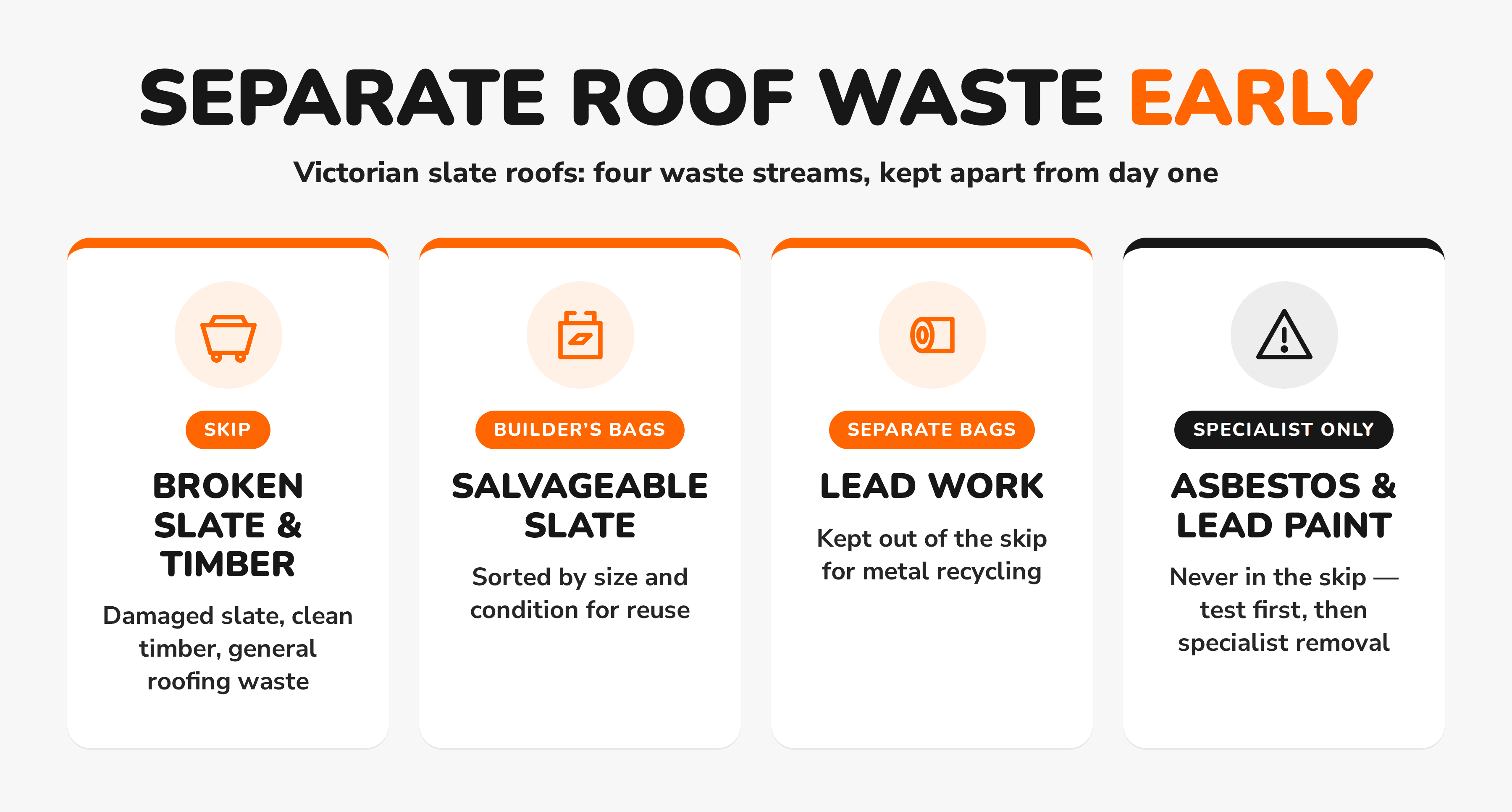
The key to roofing waste skip management on period properties is separation from day one. We use three containers:
One skip for genuinely broken slate, damaged timber and general roofing waste
Builder's bags for salvageable slates, sorted by size and condition
Separate bags for lead work, which needs specialist disposal
The timber tells its own story. Victorian roof timbers were cut from mature trees, properly seasoned, and built to last. Most of the rafters we pulled out that March were still solid enough to reuse, just darkened with age and marked by generations of woodworm that had long since given up and died.
I've found that managing roofing waste without overweight fees comes down to understanding material density. Broken slate weighs far more than you'd expect, and a skip that looks half-full can already be at its weight limit. We learned to request weight-unlimited skips for slate jobs after one expensive lesson involving a very unhappy skip driver and a £180 excess charge.
Sash Window Replacement Challenges
Victorian sash windows were engineering marvels. Box frames with hidden weights, pulleys that still worked after 130 years, glass panes held in place with putty that had turned to concrete. Removing them without destroying half the wall requires patience and a complete understanding of where your waste will end up.
The villa's front elevation had four sets of floor-to-ceiling sash windows, each one slightly different because Victorian builders worked by eye rather than standardized measurements. The frames came out in pieces, mostly, though we managed to save two complete units for the homeowner's garden workshop.
Glass disposal presents its own problems. Victorian window glass was blown, not rolled, which gives it that slightly warped quality that makes old houses feel authentic. But blown glass breaks differently than modern float glass, shatters into irregular shards that cut through standard waste bags, and can't be recycled through normal channels.
We ended up with 23 individual panes intact enough for reuse, 89 pieces of broken glass in our hazardous waste bags, and enough putty scrapings to fill a wheelbarrow. The putty alone took three hours to remove properly, and half of it contained lead paint that required specialist disposal.
Heritage Waste Disposal Requirements
Derby City Council takes heritage waste seriously, particularly around conservation areas like Darley Abbey. The rules aren't always clear, but the penalties for getting them wrong definitely are.
Lead paint removal requires licensed contractors for anything beyond minor DIY work. Asbestos testing is mandatory if you're working on any building constructed before 1980, and Victorian properties often contain asbestos in unexpected places - pipe lagging, floor tiles, even in some decorative plaster finishes.
I learned the hard way that you can't just book a standard skip and hope for the best. Contaminated loads get rejected at the tip, sent back to site, and you're liable for disposal costs plus transport plus whatever delay that causes to your project timeline. Better to separate materials properly from the start than explain to your client why their renovation just got three weeks longer.
Window Replacement Project Planning
Replacing sash windows in a Victorian villa isn't like swapping out modern casements. The work touches everything - internal decoration, external pointing, sometimes structural elements if the lintels have moved over the decades.
Planning your skip requirements means understanding that window replacement skip Derby jobs generate surprising amounts of secondary waste. You're not just disposing of old windows. You're dealing with plaster repairs, timber replacements, decorative mouldings that can't be saved, and usually a fair amount of rubble from making good around new frames.
The Duffield Road job taught me to think about windows and doors replacement skip plan requirements in stages rather than as a single event:
Initial removal phase: old frames, broken glass, accumulated debris from box frames
Preparation work: damaged plaster, rotten timber reveals, failed pointing
Installation waste: packaging, offcuts, adjustment materials
Finishing waste: old paint scrapings, plaster dust, surplus sealants and putty
Final cleanup: general debris, protective sheeting, damaged tools nobody wants to admit to
Each phase generates different types of waste with different disposal requirements. The glass goes in bags, the timber can be mixed with general building waste if it's clean, but anything contaminated with lead paint needs separating immediately.
Cost Management and Skip Sizing
Victorian villa renovations eat money like teenagers eat cereal, and waste disposal costs can spiral if you don't plan properly. The Duffield Road job used four 8-yard skips over six weeks, plus specialist collections for lead and asbestos materials.
I've found that Derby period property renovation projects need different skip sizing strategies than new builds. Modern construction generates predictable waste streams - mostly packaging, offcuts and surplus materials. Victorian work produces unknown quantities of historic debris, contaminated materials that need specialist handling, and reusable elements that take up skip space but have real value.
Eight-yard skips work best for most heritage jobs. Large enough for a day's serious demolition work, small enough to position accurately on narrow Victorian streets, and manageable for manual loading of heavy materials like slate or stone. We tried a 12-yard skip once and spent more time walking around it than filling it.
The key cost control measure is material separation. Mixed loads cost more to dispose of, contaminated loads get rejected completely, and hazardous materials require specialist collection whether you've got a teaspoon or a ton of them.
Working with Conservation Area Restrictions
Darley Abbey sits within Derby's conservation area, which means every external alteration needs planning consent and every skip needs a highway permit if it's going on the road. The permit system works, mostly, but it adds £67 per week to your project costs and requires advance booking that doesn't always align with construction timelines.
Conservation officers care deeply about authentic materials and proper restoration techniques. They also care about site management, waste storage and the visual impact of renovation work on historic streetscapes. A badly positioned skip or improperly managed waste storage can result in enforcement action that stops work until you sort it out.
I learned to photograph every stage of heritage waste removal after a conservation officer questioned whether we'd properly documented salvageable materials from a roof job in 2020. The photos saved us from having to re-examine two skips worth of broken slate, but the conversation made it clear that proper waste management is part of heritage responsibility, not just building site housekeeping.
The permit process requires specific information about skip placement, duration and waste types. Generic applications get rejected, and reapplications take another week minimum. Better to overestimate your requirements and finish early than discover you need permit extensions when half your roof is off and weather's coming in.
Seasonal Considerations for Heritage Work
Victorian houses weren't designed for partial demolition in winter. The thermal mass that keeps them comfortable year-round also means they take forever to dry out once water gets in, and heritage restoration work invariably involves opening up the building envelope.
I schedule skip hire Derby requirements around weather patterns now, after spending a miserable February in 2021 watching rainwater pour through a half-stripped roof into rooms full of period features we were supposed to be preserving. Winter work means more protective measures, more waste from damaged materials, and longer project timelines that affect skip hire scheduling.
Spring and autumn offer the best conditions for major heritage work. Dry enough for exterior work, mild enough that opening up the building doesn't create immediate problems, and daylight hours that make detailed restoration work manageable.
Summer presents its own challenges - listed building work in 30-degree heat isn't pleasant, and some traditional materials don't perform well in extreme temperatures. The seasonal pattern affects waste generation too. Winter work produces more damaged materials from weather exposure. Summer work generates more packaging waste from keeping materials cool and protected. Spring work often reveals winter damage that adds unexpected disposal requirements to the project scope.
Modern Solutions for Period Properties
Technology helps, but carefully. Modern waste management systems can track material types, optimize collection routes and ensure proper disposal certification, but they still depend on human judgment about what's worth saving and what needs to go.
Digital photography documents everything now, which helps with insurance claims, conservation approval and deciding whether borderline materials are worth keeping. But I've never seen an app that can tell you whether a piece of Victorian cast iron is worth restoring or ready for the skip.
Easyskip.uk offers online booking and tracking systems that work well for heritage projects, though I still prefer phone conversations for complex jobs where waste streams aren't straightforward. The flexibility matters more than the technology when you're dealing with materials that don't fit standard categories.
The biggest change I've seen over fifteen years of heritage work is improved specialist disposal networks. Lead, asbestos and other hazardous materials that used to require expensive specialist collections can now be handled through regional networks that reduce costs and improve turnaround times. That's made heritage renovation more accessible to ordinary homeowners, not just wealthy enthusiasts with unlimited budgets.
Start by walking your property with someone who understands both building conservation and waste management regulations. The decisions you make in the first week of planning will determine whether your renovation runs smoothly or turns into an expensive lesson in heritage compliance.